For those of us not watching ticks. Same structure, using the one-minute values so the logic reasons about bars rather than every print.
1. The rule
# BUY
if Price > Sma(60) and ChangeAngle(60) > 20:
    if BuyVol_1m > SellVol_1m:
        Buy()
# SELL
if ProfitPct >= 3.0 or ProfitPct <= -1.5 or HoldTime >= 3600:
Sell()The _1m suffix is the whole trick. If your reasoning happens on bars, your conditions should read bars. Mismatching the two is how you end up with a strategy that behaves differently from how you think about it.
2. Why a minute version at all
Per-second factors react to every tick, which is appropriate for a scalp and wrong for a trend
idea that intends to hold for twenty minutes. The _1m suffixed factors aggregate the same
underlying data over the completed minute, so the entry stops flickering.
Note that the minute in progress is included as it builds. This is not a completed-bar join.
That matters because using only completed bars would mean your live strategy and your backtest
disagree about what was known at each moment.
3. When it fails
It enters later than the per-second version by construction. In a fast move that is a real cost,
and no amount of tuning recovers it — you chose a slower clock deliberately.
4. What to change first
The averaging window, not the timeframe. Sma(60) on minute data is a very different thing from
Sma(60) on seconds. Check that the window you wrote is the window you meant.
5. What the round trip asks of it
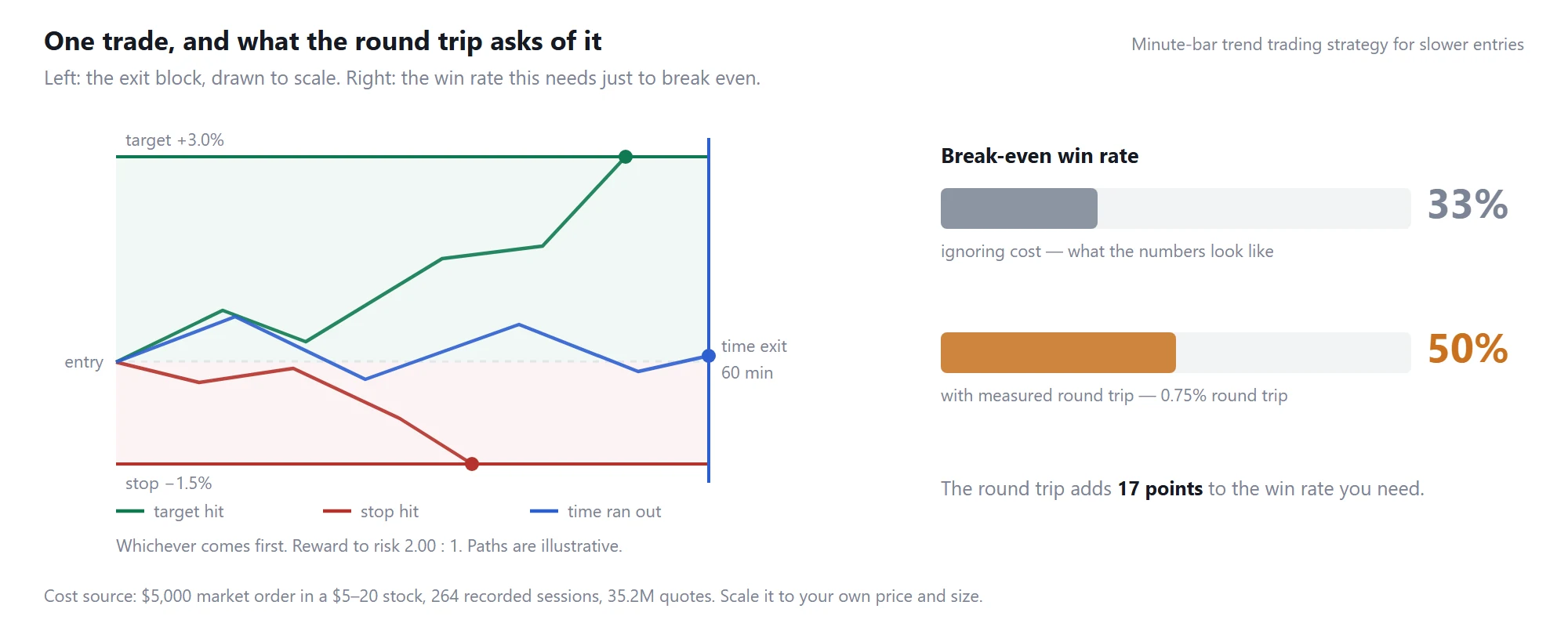
Minute-bar trend trading strategy for slower entries: the exit block drawn to scale, and the break-even win rate before and after measured trading costs
Slower entries are partly a cost decision, not only a signal one.
The 3.0% target against a 1.5% stop needs 33% before costs and 50% after — the same seventeen
point toll as any other 2:1 structure at this target size. But a minute-bar strategy takes far
fewer trades than a one-second one, and the toll is charged per trade.
That is the underrated argument for slowing down: not that minute bars see something ticks do not,
but that you pay the round trip a tenth as often. See
what day trading a US stock really costs.
Educational template for research and backtesting. Not investment advice and not a signal service.
Originally published by TraderWe on August 7, 2026. You may quote and link to this page. Republishing the full text without a link back to the original is not permitted.
Two things I'd add:
1. The partial-minute point is the important one and it's buried. If a backtest treats the in-progress minute as complete, entries land at prices you couldn't have had. Worth confirming which way your own testing handles it before you trust any of the numbers.
2. -1.5% stop with a 3% target on a 3600s cap is three parameters that will happily fit themselves to whatever window you test on. I'd freeze the exit block, sweep only the Sma window like you suggested, and see if the shape holds across different periods before touching anything else.