Sharing the version I started with and what was wrong with it, since every example here is by someone who already knows what they're doing.
1. The rule
# What I wrote first — and it "worked", which was the problem
if Price > Sma(60) and Strength > 120:
    Buy()
The entry itself was fine. What I got wrong was everything after it: I had no sell strategy at all for two days, and couldn't work out why nothing ever closed. The entry is the part that feels like the strategy, so it's the part you write first and the only part you check.
# What was actually missing
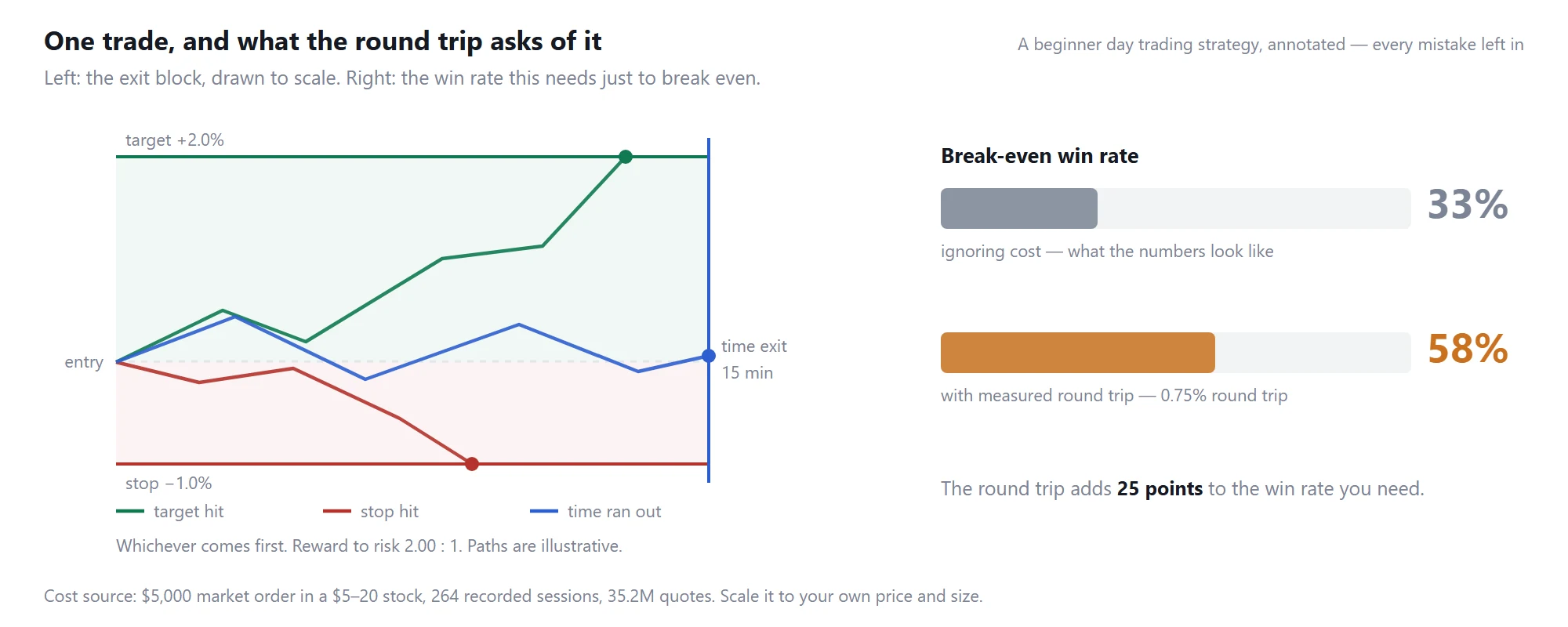
if ProfitPct >= 2.0 or ProfitPct <= -1.0 or HoldTime >= 900:
    Sell()
Three ways out. Target, stop, time — and any one of them ends the trade. Posting this because I doubt I'm the only one who spent two days on the entry and none on the way out.
2. What was missing, in order of damage
No liquidity floor. The entry fires on any symbol that happens to be in the universe,
including names where the exit costs more than the trade earns.
No spread check.Strength > 120 tends to be true exactly when the spread is widest, so
the strategy systematically enters at the worst available price.
No time exit. A trade that goes nowhere holds a position slot indefinitely. In a portfolio
with limited concurrent positions this is the most expensive omission, because it blocks trades
you would have taken.
No session close-out. Nothing forces the position flat before the bell.
3. Why it looked like it worked
Backtested on a rising sample with mid-price fills and no slippage, almost any entry that buys
strength looks profitable. The first three omissions above do not show up until fills are
priced realistically.
4. What to change first
Add the four missing pieces in the order listed. Each one reduces the result on paper and
increases the chance the strategy survives contact with a live account.
5. What the round trip asks of it
A beginner day trading strategy, annotated: the exit block drawn to scale, and the break-even win rate before and after measured trading costs
Here is the number a first strategy usually gets wrong.
The 2.0% / 1.0% exits need a 33% win rate on paper and 58% once the measured round trip is in.
Almost every beginner strategy is designed against the first number, and almost every one of them
is disappointed by the second.
Nothing about that gap is your entry's fault, and no amount of tuning the entry will close it. It
is the price of transacting, measured across 264 recorded sessions
(what day trading a US stock really costs). Knowing it in advance is most of what
separates a second strategy from a first one.
Educational template for research and backtesting. Not investment advice and not a signal service.
Originally published by TraderWe on August 6, 2026. You may quote and link to this page. Republishing the full text without a link back to the original is not permitted.