A shape rather than a strategy. Most of my ideas only make sense in part of the day, and wrapping them in a window is the first thing I do.
1. The rule
# BUY — only between two times
if HhmmSs >= 100000 and HhmmSs <= 143000:
    if Price > 0:      # replace this line with your entry condition
        Buy()
# SELL — force flat before the close regardless
if HhmmSs >= 154500:
Sell()
elif ProfitPct >= 2.0 or ProfitPct <= -1.0 or HoldTime >= 1200:
Sell()The forced flat is the part people forget. Decide whether you hold overnight deliberately rather than by omission.
2. Why a time window at all
Different parts of the session behave differently enough that one set of thresholds rarely fits
all of them. The open is fast and expensive, the middle of the day is slow, and the last half
hour has its own flows. Restricting entries to a window is the cheapest way to stop a strategy
from being tested on one regime and traded in another.
3. When it fails
The window itself can be the overfit. If 10:00 to 14:30 tests better than 09:30 to 16:00, ask
whether that is a real property of the market or a property of your sample. Try neighbouring
windows — if 10:15 to 14:15 falls apart, the edge was in the boundary, not the idea.
4. What to change first
The forced close-out time. HhmmSs >= 155000 closes ten minutes before the bell. That is a
deliberate margin: closing at 15:59 means competing with everyone else doing the same thing.
Try 15:45 and see whether your fills improve enough to pay for the earlier exit.
5. What the round trip asks of it
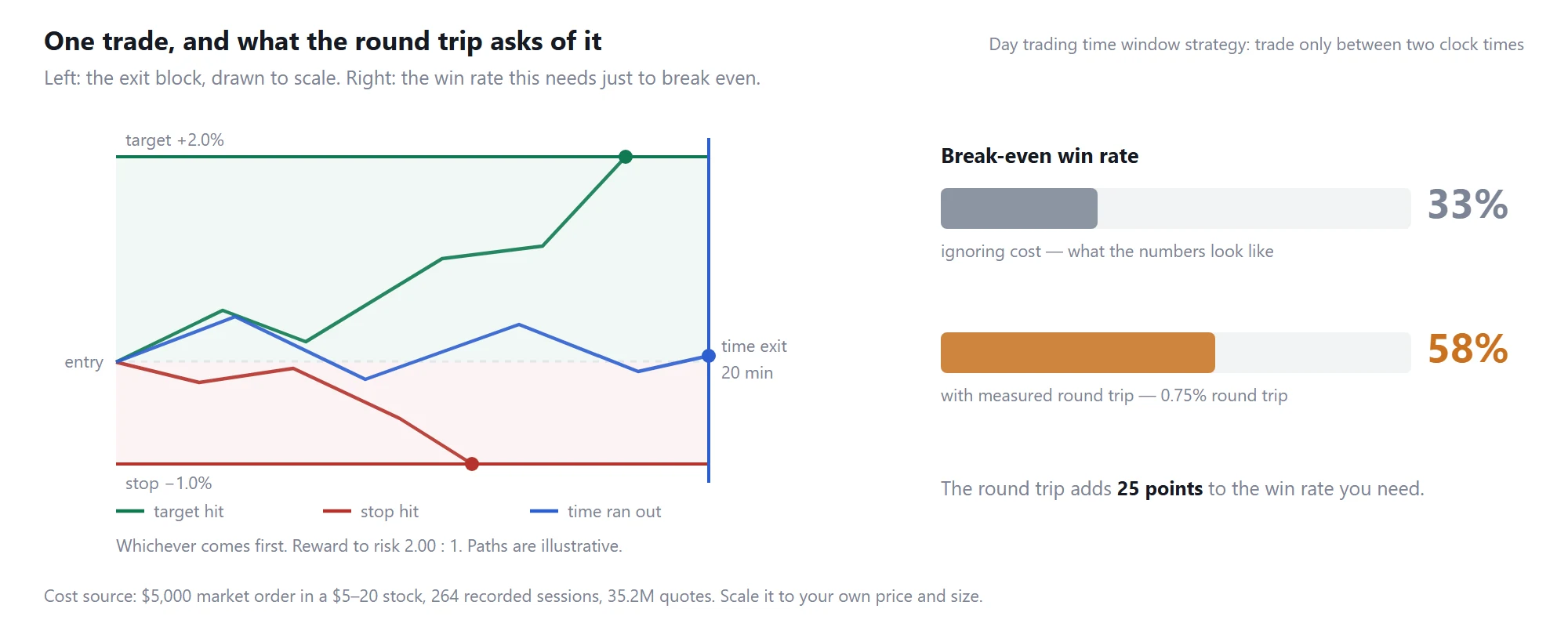
Day trading time window strategy: the exit block drawn to scale, and the break-even win rate before and after measured trading costs
The window is doing more work than it looks. A 2.0% target against a 1.0% stop needs a
33% win rate on paper and 58% with the measured 0.75% round trip
(what day trading a US stock really costs).
Twenty-five points is the toll for trading at all, and it is charged per trade. That is the
strongest argument for a time window: every hour you exclude is a set of trades you do not pay for.
A window that removes the flat middle of the session usually improves results not because those
hours are unprofitable, but because they are *marginally* profitable and the round trip eats the
margin.
Which hours to keep is measurable rather than a matter of taste — see
the opening 30 minutes is the easiest day trading window.
Educational template for research and backtesting. Not investment advice and not a signal service.
Originally published by TraderWe on May 25, 2026. You may quote and link to this page. Republishing the full text without a link back to the original is not permitted.
The forced flat clause has saved more accounts than any entry rule I ever wrote. Learned that one the hard way when a position I forgot about met a gap I did not plan for.
Yeah Karl's right, on crypto I basically just use max hold time and a soft rule about not opening anything new when I'm about to sleep. The clock still matters, just not the exchange's clock.
Curious how you picked 10:00 and 14:30 specifically. Was that from testing entry performance by hour bucket, or more feel? I'd want to see the window boundaries swept a bit before locking them in, otherwise it's easy to fit the window to a handful of good days.