The opening 30 minutes is the easiest day trading window, not the only one
By TraderWe· Published Aug 16, 2026· Updated Aug 17, 2026· 💬 5
Study details
Measured
2026-07-15 – 2026-07-31, 13 recorded sessions; 30-slot change-ranked universe
Instruments
US equities, intraday movers; regular hours, crossed quotes excluded
Method
for every symbol-minute, take the best exit available within the next ten minutes and compare it to the round-trip spread in the same window and price band. Report both the median ratio and the share of minutes that cleared the cost. Movement and cost come from the same sessions
Result
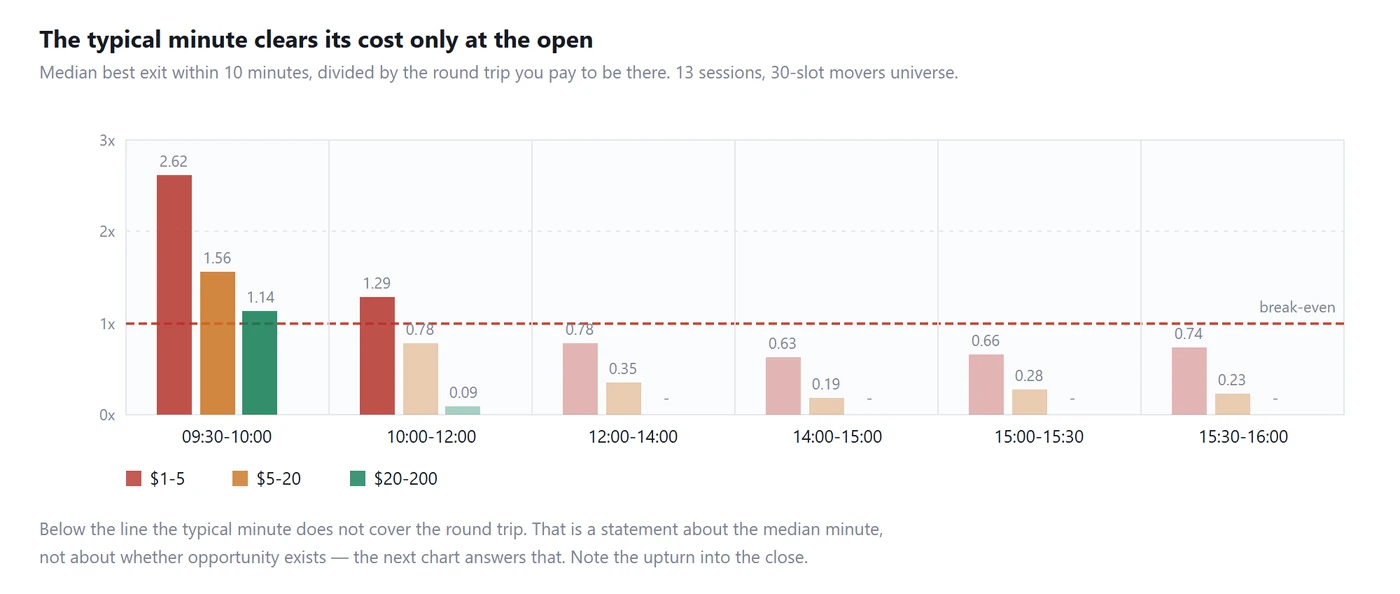
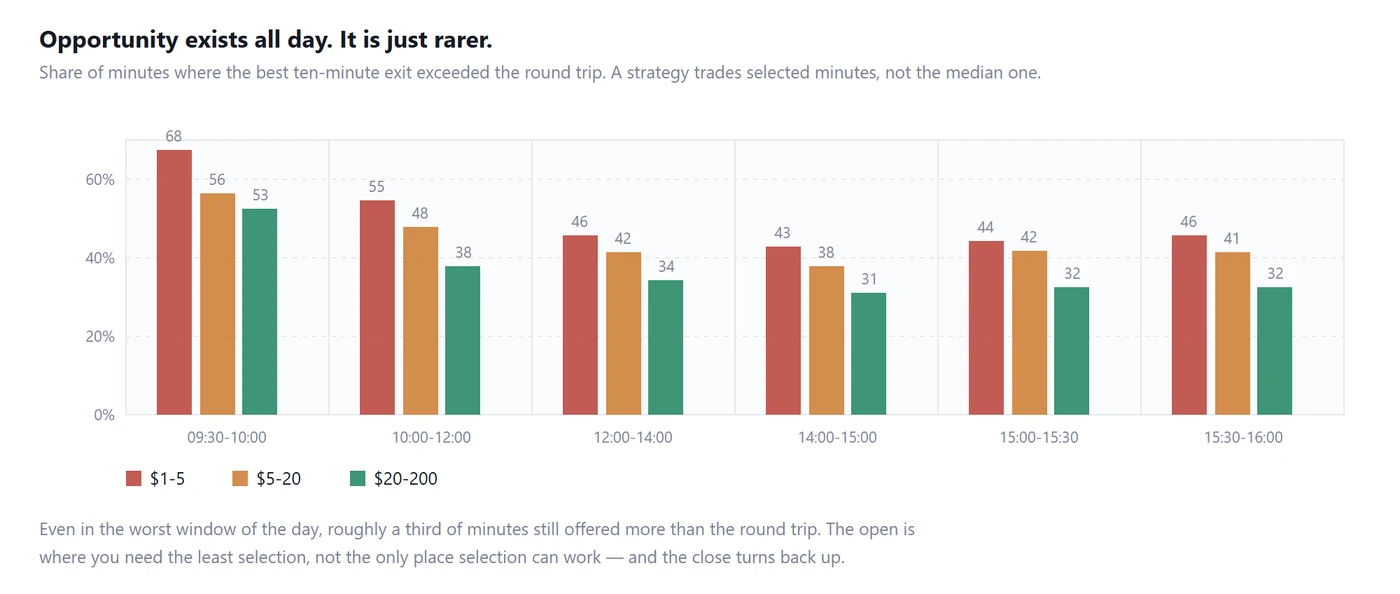
the opening half hour is the only window where the median minute clears its own cost, at 2.62x, 1.56x and 1.14x. But opportunity exists all day — even in the worst window 31% to 43% of minutes cleared the round trip, and the rate turns back up into the close
Everyone writes day trading strategies for the first thirty minutes, and everyone knows why: that is where the movement is. We have measured the other side of that trade — what it costs to be there — in spreads and depth. Both said the opening half hour is the most expensive and thinnest window of the day.
That is only half a sentence. Cost is what you pay; it says nothing about what you get. So we measured both on the same sessions and divided one by the other.
The answer has two parts, and the second one matters as much as the first.
The opening half hour is the only window where the typical minute covers its own cost. In every other window the median minute does not.
That is not the same as saying nothing else works. Even in the worst window of the day, roughly a third of minutes still offered more than the round trip. The open is where you need the least selection — not the only place selection can work.
1. What we measured
For every symbol-minute we ask two questions.
What was available? Take the entry price at that minute and look at the next ten minutes. The best exit available is the highest minute-high in that window, expressed against the entry in basis points.
What did it cost? The round-trip spread in the same window and price band — buy at the offer, sell at the bid.
We then report two different things, because they answer different questions.
The ratio of the median move to the cost tells you what an average moment offered. The share of minutes that cleared the cost tells you how often an opportunity was there at all. A strategy does not trade the median minute; it trades the minutes it selected. The first number describes the terrain, the second describes how much of it is usable.
Two things this deliberately does not do. It does not model direction. It measures what was there, not whether you could pick it. And it uses the best exit within the window rather than the price at the end of it, which is generous on purpose.
Regular hours only, crossed quotes excluded because those are usually halts, symbols that traded at least once that day. Movement and cost are computed over the same 13 sessions, which section 7 explains is not a detail.
2. The median minute only works at the open
Median best ten-minute exit divided by round-trip cost, by window and price band
$1-5
$5-20
$20-200
09:30-10:00
2.62x
1.56x
1.14x
10:00-12:00
1.29x
0.78x
0.09x
12:00-14:00
0.78x
0.35x
—
14:00-15:00
0.63x
0.19x
—
15:00-15:30
0.66x
0.28x
—
15:30-16:00
0.74x
0.23x
—
The opening half hour clears 1.0 in all three bands, by a factor of two and a half in the cheapest one. Nothing else does except $1 to $5 in late morning.
Read the bottom three rows carefully, though. They dip at 14:00 and then turn back up into the close — 0.63 to 0.66 to 0.74 in the $1 to $5 band. That upturn is real and it is the reason the afternoon is not one undifferentiated dead zone. The last half hour is measurably better than the hour before it.
It is also still below 1.0, which brings us to the number that actually answers the question.
3. Opportunity exists all day
Share of minutes where the best ten-minute exit exceeded the round trip
Share of minutes clearing the round trip
$1-5
$5-20
$20-200
09:30-10:00
67.5%
56.5%
52.6%
10:00-12:00
54.7%
47.8%
37.9%
12:00-14:00
45.8%
41.6%
34.2%
14:00-15:00
42.7%
38.0%
31.0%
15:00-15:30
44.3%
41.7%
32.5%
15:30-16:00
45.8%
41.4%
32.4%
This is the honest version of the story.
At the open, more than half of all minutes cleared the round trip in every price band. You could be close to indiscriminate and still be trading moments that paid for themselves.
In the worst window of the day, 14:00 to 15:00, it is 31% to 43%. That is far from zero. A rule that picks its moments even moderately well has plenty to work with — it simply has to pick, where at the open it barely had to.
And the close turns back up in every band, matching the ratio chart. By 15:30 the hit rate is back to the 12:00 to 14:00 level, and in the $1 to $5 band it is the same 45.8% as early afternoon. Whatever brings volume back for the closing auction shows up here too.
So the correct statement is not that the open is the only window that works. It is that the open is the window that demands the least of you, and every other window. Including the close. Asks you to be selective in exchange.
4. Why the middle of the day is hard
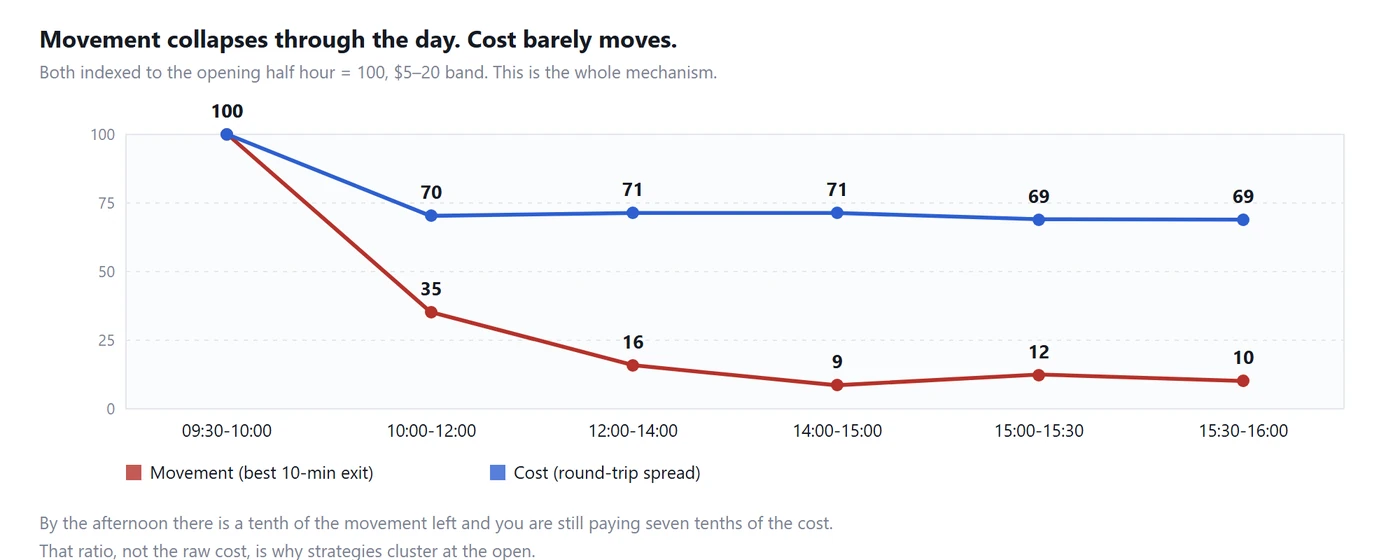
Movement and cost through the day, both indexed to the opening half hour
Index both quantities to the opening half hour and the mechanism is obvious.
$5-20 band
Movement
Cost
09:30-10:00
100
100
10:00-12:00
35
70
12:00-14:00
16
71
14:00-15:00
9
71
15:00-15:30
12
69
15:30-16:00
10
69
Movement falls to roughly a tenth. Cost falls only to seven tenths.
The spread narrows after the open — our earlier measurement showed that clearly — but it narrows once, by about 30%, and then flattens for the rest of the session. Movement does not flatten. It keeps decaying until early afternoon.
So the opening half hour being expensive was never the interesting fact. Expensive matters only relative to what is on offer, and what is on offer falls far faster than the price of admission.
5. What you pay for being there
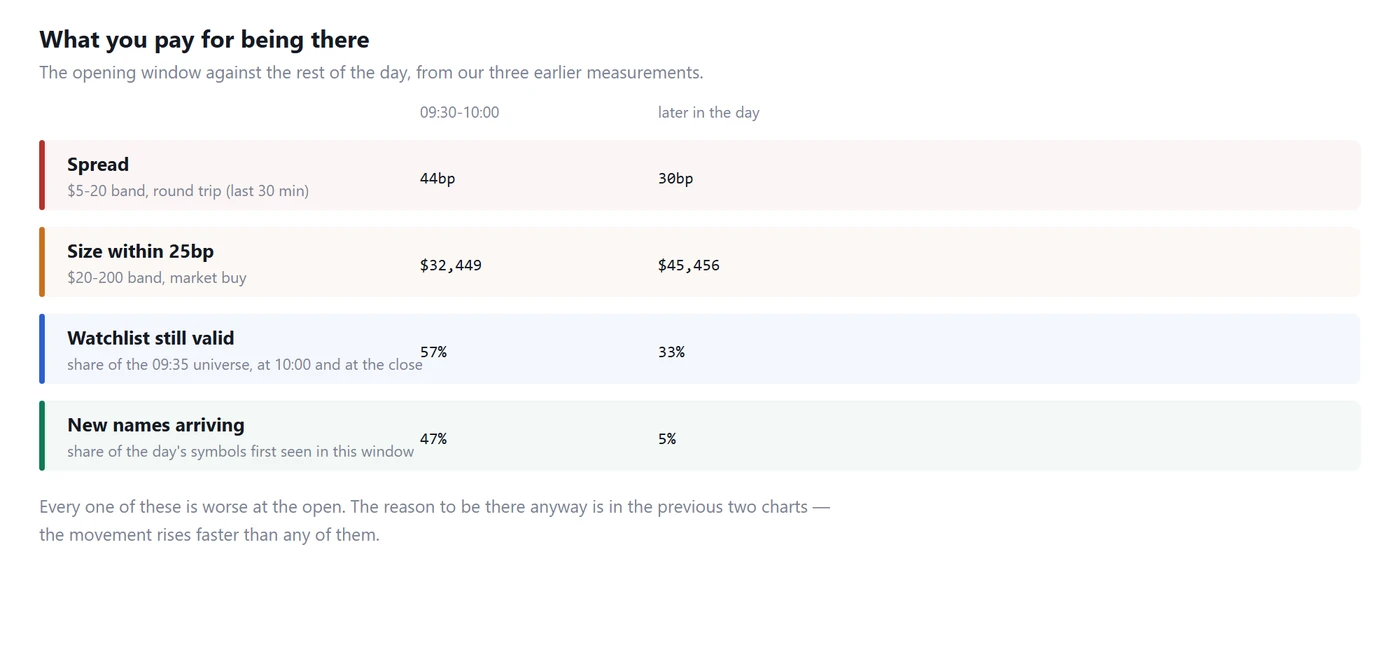
The opening window against the rest of the day across four measurements
None of this makes the opening window comfortable. Everything about execution is worse there.
09:30-10:00
Later
Spread, $5-20 round trip
44bp
30bp
Size within 25bp, $20-200
$32,449
$45,456
Share of the 09:35 watchlist still in the universe
57% at 10:00
33% at the close
Share of the day's symbols first appearing
47%
5% after 14:00
The spread is about 45% wider than at the close. The book supports 29% less size before you start walking up it. And the field itself is unstable — half the names you are watching at 09:35 are gone by 10:00, while nearly half of the day's symbols arrive during that same half hour.
That last row matters. The opening window is not just volatile in price, it is volatile in membership — the set of things you are allowed to trade turns over faster than at any other point in the session.
6. What this means for a strategy
Match the window to how selective your rule is. A rule that fires often needs the open, where over half of minutes clear the cost. A rule that fires rarely and picks well can work later, and the close is the best of the later options.
Your target has to clear the round trip, not the spread you hope for. A rule aiming at 30 basis points in a $5 to $20 stock is aiming below the round trip at the open and far below it in the afternoon. It can still work with excellent timing, but it starts behind.
An afternoon rule has to be better, not just different. At a median 0.19x to 0.35x, capturing the typical afternoon move loses money. Working there means being in the 31% to 42% of minutes that cleared, consistently. Which is a real edge, not a schedule change.
The close deserves its own test. It is the only part of the afternoon that improves, in both measures, in every band. If you have been treating 14:00 to 16:00 as one block, split it, we were, and it hid this.
Cheap stocks clear the bar most easily and scale worst. The $1 to $5 band has the best ratio and hit rate in every window, and the least capacity — about $1,155 at the best offer. A ratio you cannot size is a hobby.
If your backtest fills at the last price, none of this exists. Every number here is the gap between a fill at the touch and a fill at the mid.
7. A sampling problem we had to solve first
Sample coverage and the difference it makes to the result
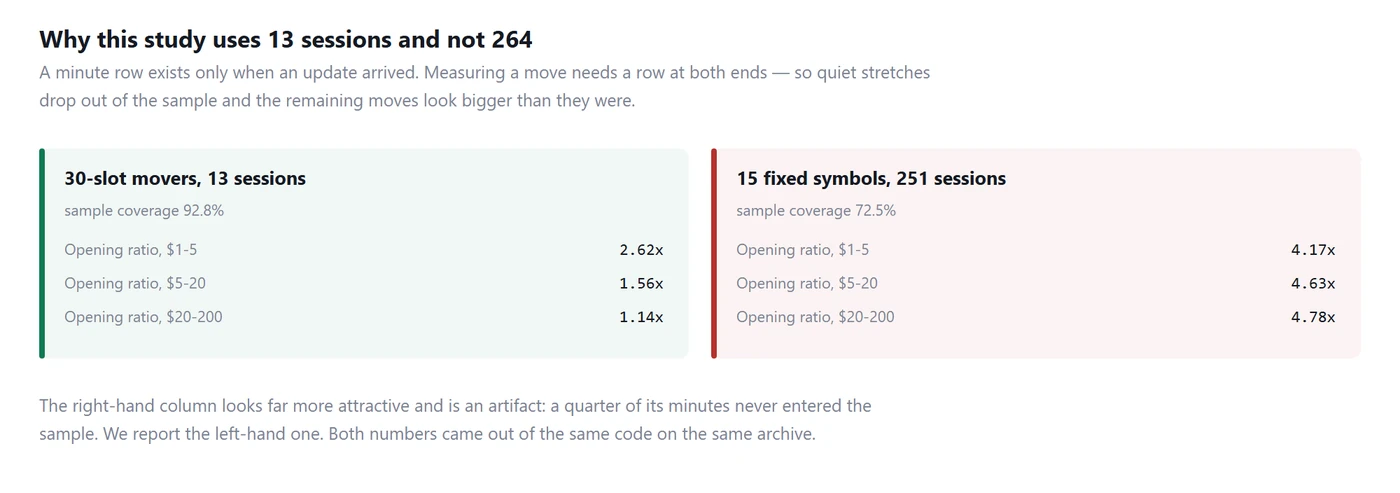
The first version of this measurement gave much better numbers, and they were wrong.
Our recorder writes a per-minute row when an update arrives. Measuring a ten-minute move needs a row at both ends of the window. If a symbol goes quiet no rows are written, the window is skipped, and the sample fills up with the moments where something was happening. The surviving moves look larger than the market actually offered.
Coverage
Opening ratio, $1-5
$5-20
$20-200
30-slot movers, 13 sessions
92.8%
2.62x
1.56x
1.14x
15 fixed symbols, 251 sessions
72.5%
4.17x
4.63x
4.78x
The 251-session archive is twenty times larger and produces numbers roughly three times more flattering. It is also missing a quarter of its minutes. We report the smaller, denser sample.
8. Method and limits
Movement is the highest minute-high over the ten minutes following an entry minute, divided by the entry price, in basis points. Cost is the median quoted spread for the same window and price band over the same sessions. The hit rate is the share of entry minutes whose best exit exceeded that cost. Regular trading hours, quotes not crossed, symbols that traded at least once that day. The sample is 13 sessions from 2026-07-15 to 2026-07-31 on a 30-slot change-ranked universe.
Best exit is not your exit. We measure what was available with perfect timing, which nobody achieves. Read the ratio as an upper bound on what a window offers. A window at 1.14x is not 14% of margin. It is a window where even a perfect exit barely clears the spread. The hit rate has the same caveat: those minutes contained the move, they did not hand it to you.
Thirteen sessions in one month. Consistent across them and consistent with our cost and depth measurements, but two weeks in July 2026 is two weeks in July 2026.
This is not a claim about profitability. We measured what the market offered against what execution costs. Whether a particular rule captures it is a different question that this kind of measurement cannot answer.
One broker's spreads, one universe. Change-ranked movers, which is the population a day trading strategy trades and not a description of the market.
The US stock backtest walkthrough covers recording the data this was measured on, and the factor reference documents the session factors used to restrict a strategy to a window.
Originally published by TraderWe on August 16, 2026. You may quote and link to this page. Republishing the full text without a link back to the original is not permitted.
Funny reading this as a crypto night person, no opening bell for me, but the idea that cost and movement have to be measured together is something I never actually did. I just assumed quiet hours were cheap because nothing was happening.
Funny reading this as a crypto night person, there's no opening bell in my world, but the idea of measuring what you get against what you pay in the same window is something I've honestly never done. I just assumed the quiet hours were cheap because nothing moves.
Useful. Adding to checklist: 1) stop treating the open as the only tradeable block 2) check cost and movement together, not separately 3) look again at the last stretch before the bell.
What stays with me is the reminder that the crowded window is easy, not special. A lot of my worst impatience came from believing that if I missed the first stretch the day was already gone.
Been at this long enough to remember when the open was the only time you could get filled at all without paying through the nose all day. What I'd want to know is whether the late-day pickup holds up when the tape is dull, or if it's just the busy sessions carrying the average. Thirteen sessions is a thin slice to hang a habit on. Stay humble.