A crypto momentum trading strategy with a hard cap on hold time. Crypto has no close, so nothing
ends a bad trade for you. Every rule below except the entry exists to supply the ending the market
will not.
1. The rule
# BUY
if ChangeAngle(60) > 20 and Strength > 115:
    if DayAmount > 20000000:
        Buy()
# SELL — three ways out, the last one unconditional
if ProfitPct >= 2.0:
Sell()
elif ProfitPct <= -1.5:
Sell()
elif HoldTime >= 3600:
Sell()
2. Why the hold cap is the important line
ChangeAngle(60) > 20 asks the change rate to rise about 4.4 points over the last minute —
demanding enough to skip drift, low enough to actually occur.
But the line that defines this strategy is the last one. In equities the session boundary ends
every position whether you planned it or not. In crypto there is no boundary at all, so a position
opened on a momentum read at 22:00 is still open at 08:00 unless something in your code ends it.
Set that cap to a duration you would be comfortable discovering while asleep. That is not a figure
of speech — it is the actual decision you are making when you type the number.
3. What can go wrong while you are not watching
Two things, and neither is about the signal.
The first is a stale feed. If your connection drops or the venue throttles updates, HoldTime
still advances but your price does not — we measured how often quotes stop updating while the book
keeps moving (stale quotes in crypto market data).
The second is depth. Overnight books are thinner than daytime books, so a position sized against
daytime depth can walk several levels on the way out
(the real cost of crypto trading).
4. What the round trip asks of it
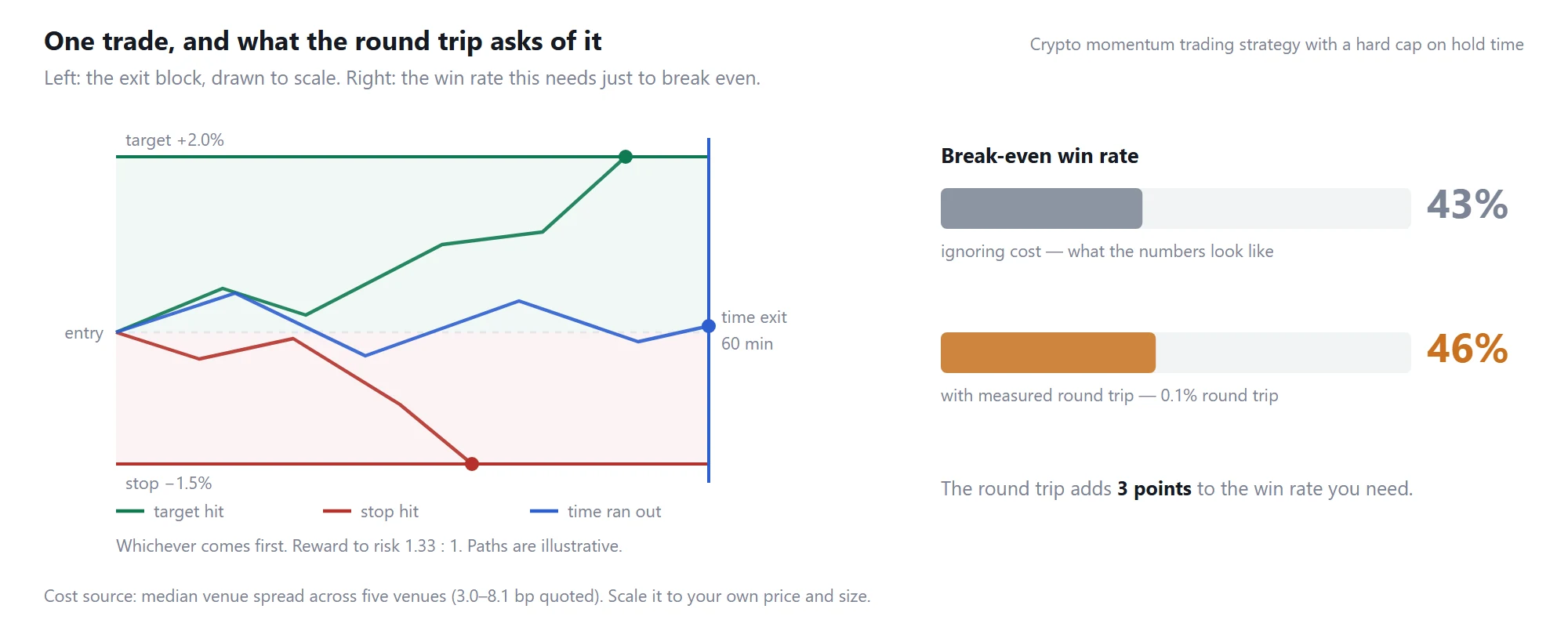
Crypto momentum with a hold cap: the exit block drawn to scale, and the break-even win rate before and after measured trading costs
At a measured round trip of about 0.10% on liquid pairs, the 2.0% target against a 1.5% stop moves
from a 43% break-even to 46%.
Three points. That is what a liquid crypto pair costs you, and it is why the DayAmount floor is
not decoration: drop to the thin end of the listings and the same structure can cost twenty times
that.
5. What to change first
The cap, in both directions. Try 7200 and see whether your winners were being cut; try 1800 and see
whether your losers were being allowed to develop. One of those two comparisons will tell you what
the current number is actually doing, which is more than most people know about their own exits.
Backtest against your own recording: how to backtest a crypto trading strategy.
Educational template for research and backtesting. Not investment advice and not a signal service.
Originally published by TraderWe on August 13, 2026. You may quote and link to this page. Republishing the full text without a link back to the original is not permitted.
Two things I'd want tested before running this live: 1) how sensitive the results are to the hold cap length specifically, because if shaving or extending it a little swings the whole curve you've just fit the cap to your sample, and 2) whether the exit is doing the work or the entry filter is - I'd run the same entry with only the time exit and no profit/loss targets to see how much each leg actually contributes. The article says everything but the entry exists to end the trade, which I like as a framing, but it also means three of your four rules are tuned parameters and that's where overfitting usually hides.
The bit about picking a cap you'd be okay finding when you wake up hit a nerve - I once left something open overnight on a coin thinking I'd check at some point, and I did check, at about 4am, which is not a time any decision of mine has ever gone well.
Good point on the stale feed - would've liked more on that half. My checklist now: cap set before entry, no manual extending, log the exit reason so I can see later which of the three fired.