The most common mistake with perpetuals is raising leverage and leaving the exit rules alone.
Leverage multiplies the position, not the distance price travels — so the stop loss has to move.
1. The rule
# SELL — scale the stop to how much the instrument actually moves
if Volatility(900) > 1.5:
    if ProfitPct >= 3.0 or ProfitPct <= -2.0 or HoldTime >= 2400:
        Sell()
elif ProfitPct >= 1.5 or ProfitPct <= -1.0 or HoldTime >= 1800:
    Sell()
2. What leverage does and does not multiply
Quantity
Changes with leverage?
Size of your position
yes
Profit and loss in account terms
yes
Distance price actually travels
no
Where your stop should sit
no
That table is the whole argument. A fixed 1% stop means something different on a calm instrument
than on a violent one: on the calm one it is a considered exit, on the violent one it is noise
closing your position. Leverage does not change which of those it is — it only changes how much the
mistake costs.
Reading the recent coefficient of variation and widening target and stop together keeps the shape
of the trade constant while the market changes underneath it. Note that the wider branch also has a
longer time cap; a wider stop needs more time to be worth taking.
3. The number that actually depends on leverage
Your position size, and nothing in the exit block. A 2.0% stop at 10x is 20% of the margin
committed to that trade. The exit rule did not change; what changed is what you can afford to have
open at once.
That is the calculation worth doing before you raise leverage, and it belongs in position sizing
rather than in the strategy.
4. What the round trip asks of it
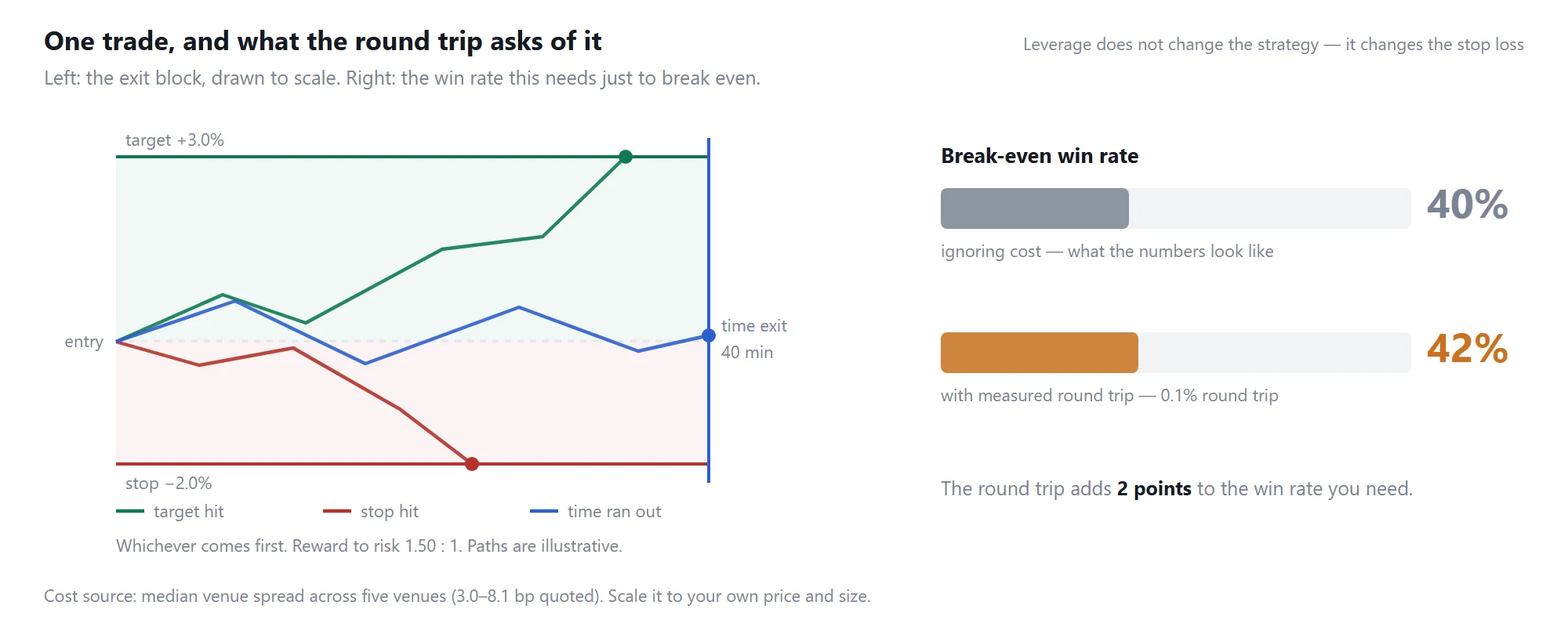
Volatility-scaled exits: the wide branch drawn to scale, and the break-even win rate before and after measured trading costs
Drawn above is the high-volatility branch. The 3.0% target against a 2.0% stop needs 40% on paper
and 42% at a measured perpetual round trip of about 0.10%
(the real cost of crypto trading).
Two points, and it is worth noticing that leverage does not appear anywhere in that calculation
either. Break-even win rate is a property of the target-to-stop ratio and the cost, both of which
are unlevered. Leverage changes your variance, not your edge — which is the least intuitive and
most expensive thing about it.
5. What to change first
The volatility threshold, measured rather than guessed. Record Volatility(900) at every entry
across a few weeks and look at the distribution: if 95% of your entries fall on one side of 1.5,
the branch you wrote is not doing anything.
Then size the position against the wider stop rather than the narrower one, so a regime change
does not quietly double your risk per trade.
Educational template for research and backtesting. Not investment advice and not a signal service.
Originally published by TraderWe on August 13, 2026. You may quote and link to this page. Republishing the full text without a link back to the original is not permitted.
Been saying a version of this since the pit days, the size of the bet and the distance the market breathes are two different animals, and folks keep multiplying the first while pretending the second moved with it. Only thing my old blowups had in common was a stop set where it was comfortable for me instead of where it was meaningful for the instrument. I do want the article to say more about how long a lookback you use for that volatility read, since a quiet stretch right before a wild one will lie to you. Stay humble.
YES the stop-and-size thing is what nobody does! If you widen the stop for the violent one you HAVE to cut the size or you just doubled your risk while congratulating yourself on being adaptive lol. Also. Is the vol read the same lookback for both branches? Mine flips back and forth right at the threshold when the market can't decide, so I ended up making it sticky once a trade is open.