A futures trading strategy that takes both directions. On perpetuals the strategy decides the side
per entry. The read that says "not going up" is not the same as one that says "going down", so
each branch gets its own conditions.
1. The rule
# BUY — direction chosen per entry
if ChangePct >= 3 and Strength > 130:
    Long()
elif ChangePct <= -3 and Strength < 70:
    Short()
# SELL — same exit for either side
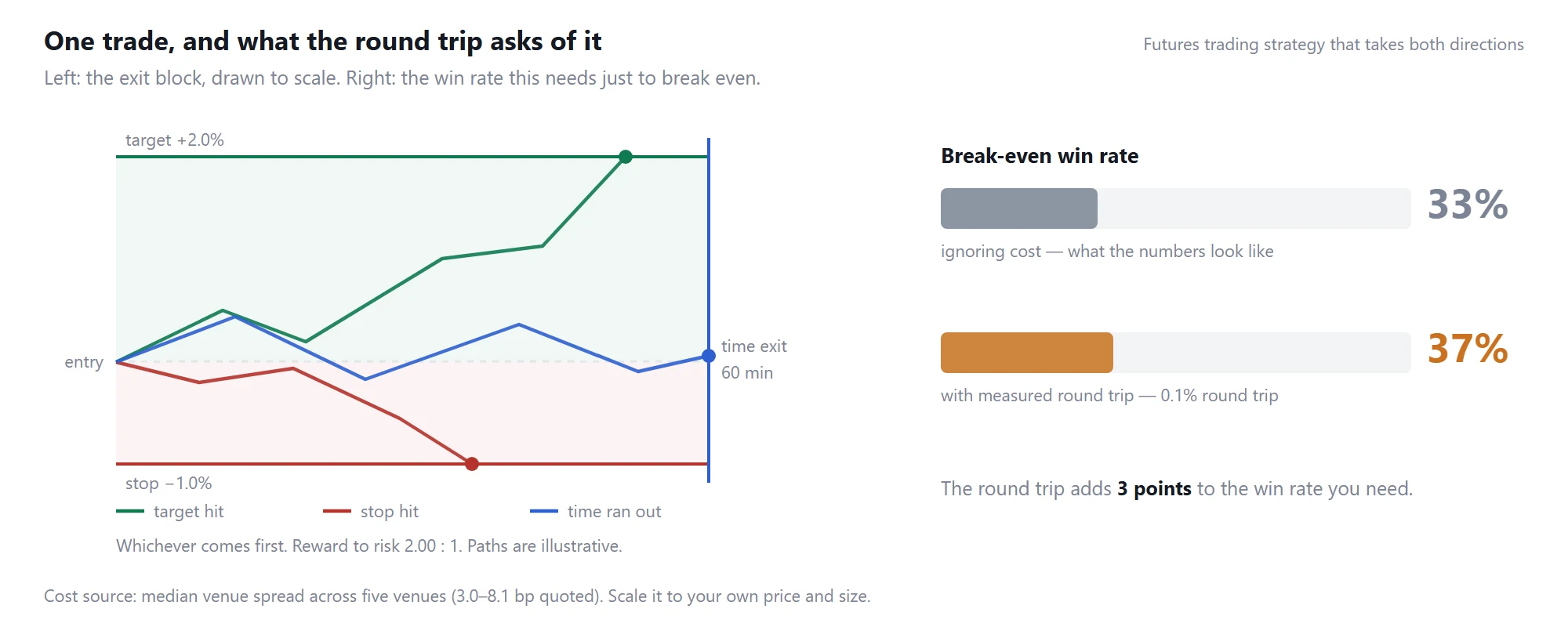
if ProfitPct >= 2.0 or ProfitPct <= -1.0 or HoldTime >= 3600:
Sell()
2. Why one exit covers both sides
ProfitPct is signed relative to the direction you took. A short that falls 2% and a long that
rises 2% both report ProfitPct = 2.0, so a single exit block covers both sides without
mirroring anything.
The entries are not mirrored, though, and that is deliberate. Strength is cumulative buy volume
over cumulative sell volume times 100, capped at 500. Above 100 means buyers have been paying up.
Requiring above 130 for longs and below 70 for shorts means both directions need agreement from
the tape, not just a price move — a 3% drop with Strength still at 140 is buyers absorbing a
flush, which is the opposite of what a short wants.
3. What leverage does and does not change
Nothing above mentions leverage, and that is correct. Leverage does not change which trades the
strategy takes; it changes what a losing one costs. The -1.0 stop is one percent of the
instrument's move, and at 10x that is ten percent of your margin. See
leverage does not change the strategy — it changes the stop loss.
4. When this works and when it does not
Momentum in both directions works when moves persist, which on perpetuals usually means a
liquidation cascade or a funding-driven squeeze. It works badly in chop, where a 3% move reverses
before your hour is up and the time exit closes you flat minus two spreads.
The other thing to size correctly is funding. A one-hour hold pays little, but if you widen
HoldTime you are taking a funding position as well as a directional one, and on a crowded side
that can be larger than the edge you are chasing.
5. Before you trade it
Backtest on your own recordings — see how to backtest a crypto trading strategy —
and check the long and short branches separately. It is common for one side to carry all the
profit while the other quietly gives it back, and a combined equity curve hides that completely.
Note that from a US IP, Binance futures order endpoints are blocked; market data and recording
work, order routing does not.
6. What the round trip asks of it
Futures long and short: the exit block drawn to scale, and the break-even win rate before and after measured trading costs
On perpetuals the measured round trip is around 0.10%, so the 2.0% / 1.0% structure barely moves:
33% break-even becomes 37%. Perpetual books were deeper than spot in 33 of the 38 pairs we
measured (the real cost of crypto trading).
Execution is not the constraint here. Funding is, if you widen the hold — which is the one change
in section 5 that quietly changes what you are trading.
Educational template for research and backtesting. Not investment advice and not a signal service.
Originally published by TraderWe on August 13, 2026. You may quote and link to this page. Republishing the full text without a link back to the original is not permitted.
- like that the short leg isn't just the long rule flipped
- the absorbed-flush point is the bit I'd have gotten wrong
- article gets cut off right where leverage starts, anyone got the rest?
love that the exit block is one line for both sides, way less stuff to get wrong at 6am when i'm half awake. quick q though. Do you use the same 3% / 130 numbers on every pair or do the quieter ones need looser thresholds?
The signed profit thing is neat and saves duplicating an exit block, but I'd gently point out that leverage does change one thing the article seems about to say it doesn't: your stop distance stays the same in price terms while the account-level damage scales, so sizing has to shrink as leverage goes up or the fixed loss exit stops meaning what you think it means.