A short selling strategy with its own conditions, posted separately because mirroring a long entry
rarely works. Falls are faster and shallower than rises, so the same thresholds produce a different
trade.
1. The rule
# BUY — short only
if ChangePct <= -2 and Strength < 75:
    if ChangeAngle(60) < -15 and DayAmount > 30000000:
        Short()
# SELL — smaller target and tighter time than the long version
if ProfitPct >= 1.2 or ProfitPct <= -0.9 or HoldTime >= 1200:
Sell()
2. Why the numbers are not the long ones flipped
Long version
This short version
Reason
target 2.0%
target 1.2%
a fall that has already run a minute has spent most of its distance
hold 3600s
hold 1200s
falls resolve faster than rises
ChangePct >= 3
ChangePct <= -2
a smaller move is enough to matter on the way down
ChangeAngle is signed, so a negative threshold reads as a falling change rate — about 3.2 points
of decline over the last minute at −15 degrees.
The asymmetry is the content of this strategy. If you take nothing else from it, take this: a short
book written by mirroring a long book will hold too long and ask for too much, and it will do so in
the direction that moves fastest against you.
3. What a short adds that a long does not have
A short on perpetuals pays or receives funding depending on which side is crowded, and in a falling
market the short side usually is. On a 20-minute hold that is negligible; if you widen the cap it
stops being negligible, and it works against exactly the trade you are trying to make.
There is also no equivalent of the session close to save you. Everything that ends this position is
in the block above.
4. What the round trip asks of it
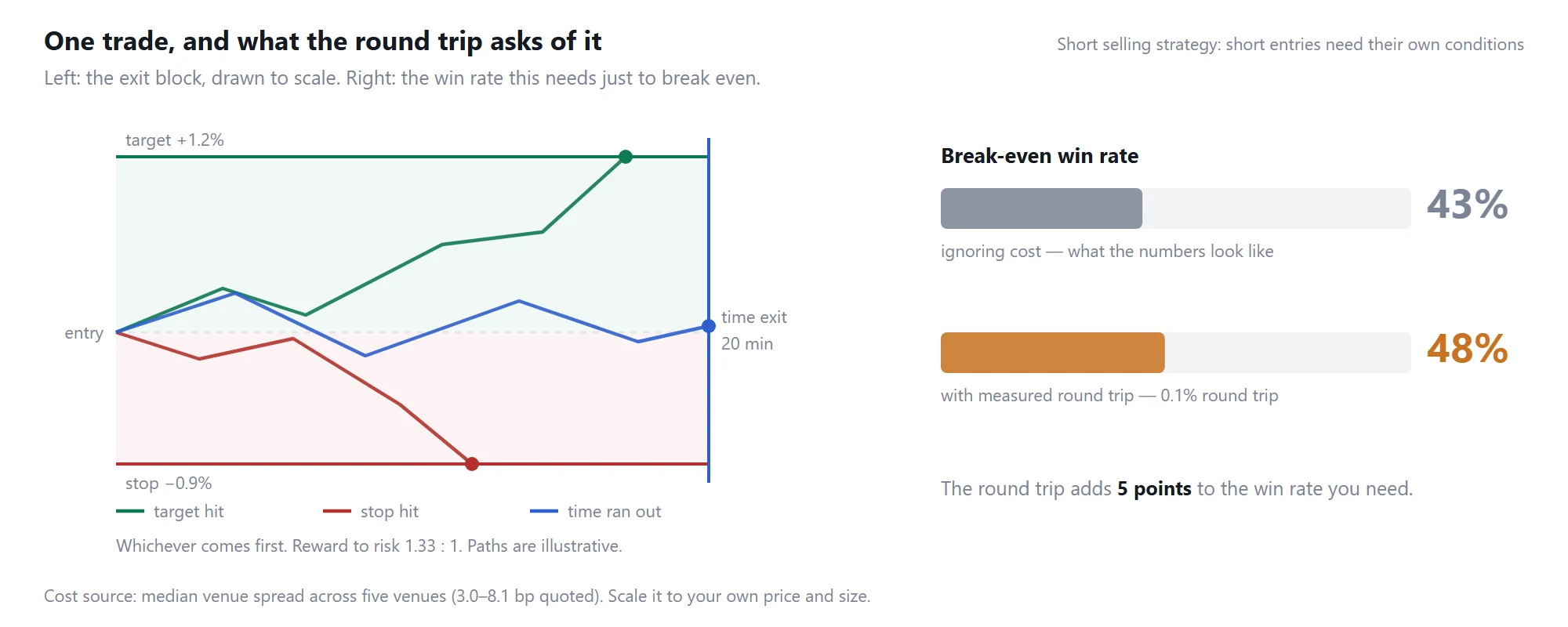
Short entry on perpetuals: the exit block drawn to scale, and the break-even win rate before and after measured trading costs
The 1.2% target against a 0.9% stop needs 43% on paper and 48% at a measured perpetual round
trip of about 0.10% (the real cost of crypto trading).
Five points, which is the price of the smaller target. It is a reminder that shrinking the target
is never free: this is the same structure that would cost thirty-plus points on a US small cap, and
it is only workable because perpetual execution is cheap.
5. What to change first
Run the long and short branches as separate strategies and look at their equity curves separately.
It is common for one side to carry all the profit while the other quietly gives it back, and a
combined curve hides that completely.
Note that from a US IP, Binance futures order endpoints are blocked; market data and recording work,
order routing does not. How to backtest a crypto trading strategy covers the
recording side.
Educational template for research and backtesting. Not investment advice and not a signal service.
Originally published by TraderWe on August 13, 2026. You may quote and link to this page. Republishing the full text without a link back to the original is not permitted.
morning all ☕ the bit that stuck with me is that a short book copied from a long book will sit in the trade too long and ask for too much. I have definitely done exactly that and never thought of it as a mistake, just bad luck. also the article got cut off right where it was about to say what a short adds that a long doesn't, does anyone have the rest? curious about the funding/borrow side since that's the part I always forget when I hold longer than planned.
I learned this one the expensive way — took my long template, flipped the sign, and left the 2% target on it. Every short I opened would go green half a point and then some squeeze would take it back off me before I ever saw the target. Held one for the full long-sized time cap out of stubbornness and watched it round trip through my stop. Not saying your numbers are right, just that mine were definitely wrong for exactly the reason you're describing.