A deliberately restrictive day trading entry, built around the observation that most losses come
from trades taken because nothing was happening.
1. The rule
# BUY — deliberately restrictive
if HhmmSs >= 101500 and HhmmSs <= 141500:
    if ChangeAngle(60) > 30 and Strength > 130 and DayAmount > 20000000:
        Buy()
# SELL
if ProfitPct >= 3.0 or ProfitPct <= -1.2 or HoldTime >= 2400:
Sell()
2. Four conditions, four kinds of bad trade
Line
Removes
HhmmSs between 10:15 and 14:15
the open, where spreads are widest, and the close, where you are racing the bell
ChangeAngle(60) > 30
names that are drifting rather than moving
Strength > 130
moves the tape does not agree with
DayAmount > 20000000
names where the fill costs more than the move is worth
It will sit still for whole sessions. That is intended. If you find yourself loosening the
conditions because it is not trading, notice that impulse — it is the same one that costs money
when you trade by hand.
3. Degrees are not size
If you widen the window, lower the angle with it. ChangeAngle(n) is a slope in degrees, so the
same number over a longer stretch is asking for a much larger move. That is a good part of why this
entry fires as rarely as it does, and it was deliberate here. It should be deliberate for you too.
4. What the round trip asks of it
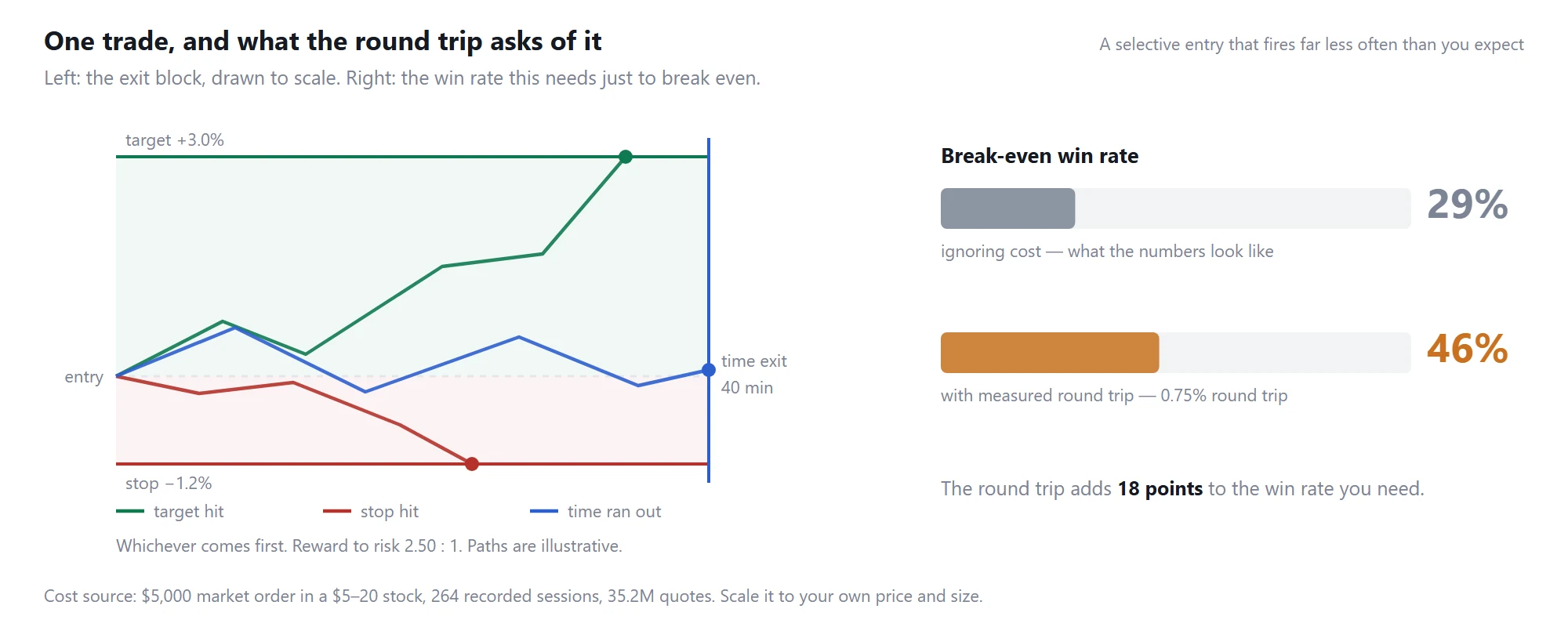
Selective entry: the exit block drawn to scale, and the break-even win rate before and after measured trading costs
The 3.0% target against a 1.2% stop needs 29% on paper and 46% with the measured 0.75% round
trip (what day trading a US stock really costs).
That 17-point toll is the smallest of any US stock strategy in this library, and the reason is the
target, not the entry. A large target dilutes a fixed cost. Selectivity and a wide target belong
together for exactly this reason: if you are only going to trade three times a week, each trade has
to be worth the toll.
5. What to change first
Nothing, for a while. Run it as written across at least forty sessions before you touch a
threshold, because a strategy this selective produces very little evidence per session and the
temptation to tune on ten trades is enormous.
When you do change something, change the time window first and compare against
the baseline your trading strategy has to beat rather than against the previous
version of itself. Backtest on your own recordings:
how to backtest a day trading strategy on US stocks.
Educational template for research and backtesting. Not investment advice and not a signal service.
Originally published by TraderWe on June 23, 2026. You may quote and link to this page. Republishing the full text without a link back to the original is not permitted.
The exit block is doing more work than people will notice: 3.0 up against 1.2 down means you can be wrong more often than right and still be fine, but only if you don't size up out of boredom. My checklist item for strategies like this is literally "did I change anything today, and why" — write the why down before you touch the number.
Question on the window: did you test anything between 60 and 600, like 180? Curious whether the angle drops off linearly the way your note implies or if it gets noisy in the middle.
Same impulse exists in perps but there's no 14:15 to save you, the thing just sits there open all weekend whispering. I've started using a hard "no entries after X" rule for myself for exactly this reason.
Worth putting numbers on Rita's point. With a 3.0 target and a 1.2 stop your reward:risk is 2.5, so breakeven win rate is 1/(1+2.5) = about 28.6%. Every filter you loosen is you trading win rate for trade count, and the question is whether the extra trades clear 28.6%, usually the marginal ones don't, because they're the ones the filter was built to exclude. The other half is the HoldTime exit: those close somewhere between the two, so your real average loser is a bit smaller and your real average winner is too, which pushes the breakeven up a little. Track the three exit types separately or the blended number will lie to you.
My swing setups trade maybe twice a month and I've made peace with it. You day traders discover patience at 1s resolution and act like it's a revelation.
2400s hold is 40 min. fine. but check what the time-stop trades look like separately from the 3.0 exits. if the timeouts are all slightly red you've got a stale-entry problem, not an exit problem.
Have you ever counted how many of the trades the filters rejected would have been winners? Not to loosen anything, just curious whether you know the cost of the filter or only the benefit.
The degrees thing finally clicked reading your note, I was treating ChangeAngle like a fixed threshold and wondering why nothing fired when I bumped the window. Dumb question though: if you tune the angle and Strength numbers by trying values until it trades a reasonable amount, isn't that just the loosening impulse wearing a lab coat? Genuinely not sure where the line is.
I ran something with this shape last year and the version that killed me wasn't loosening the entry, it was moving the stop from -1.2 to -2 because I kept getting shaken out right before it turned. Felt so justified at the time. The wins stayed the same size and the losses got bigger, which in hindsight is exactly what I signed up for.