A pullback day trading strategy for US stocks: rather than buying strength, it waits for a pause
inside it. Fewer trades, and the ones you get have a nearer reference for the stop.
1. The rule
# BUY
if Price > Sma(600) and ChangeAngle(120) > 8:
    if Price <= Sma(120) and Strength > 100:
        Buy()
# SELL
if ProfitPct >= 2.0 or ProfitPct <= -1.0 or HoldTime >= 1500:
Sell()
2. Two averages doing different jobs
Condition
Job
Price > Sma(600)
the regime — is there an uptrend at all?
ChangeAngle(120) > 8
is that trend still moving, not just sitting above an average?
Price <= Sma(120)
the pullback — has price come back to the short average?
Strength > 100
are buyers still in control through the pullback?
Changing either average changes a different thing, which makes this far easier to tune
deliberately than a single-condition strategy. Widen the long one and you trade fewer, larger
trends; widen the short one and you demand a deeper pullback before entering.
The fourth line is what separates a pullback from a reversal. If Strength has fallen below 100
by the time price reaches the short average, this is not a pause in an uptrend — it is the start
of something else.
3. The angle scales with the window
ChangeAngle(120) > 8 is a slope in degrees, and the window is short on purpose. Using the same
threshold on a longer lookback makes the entry go quiet — not because the idea stopped working,
but because the condition got much harder without you touching the number.
4. What the round trip asks of it
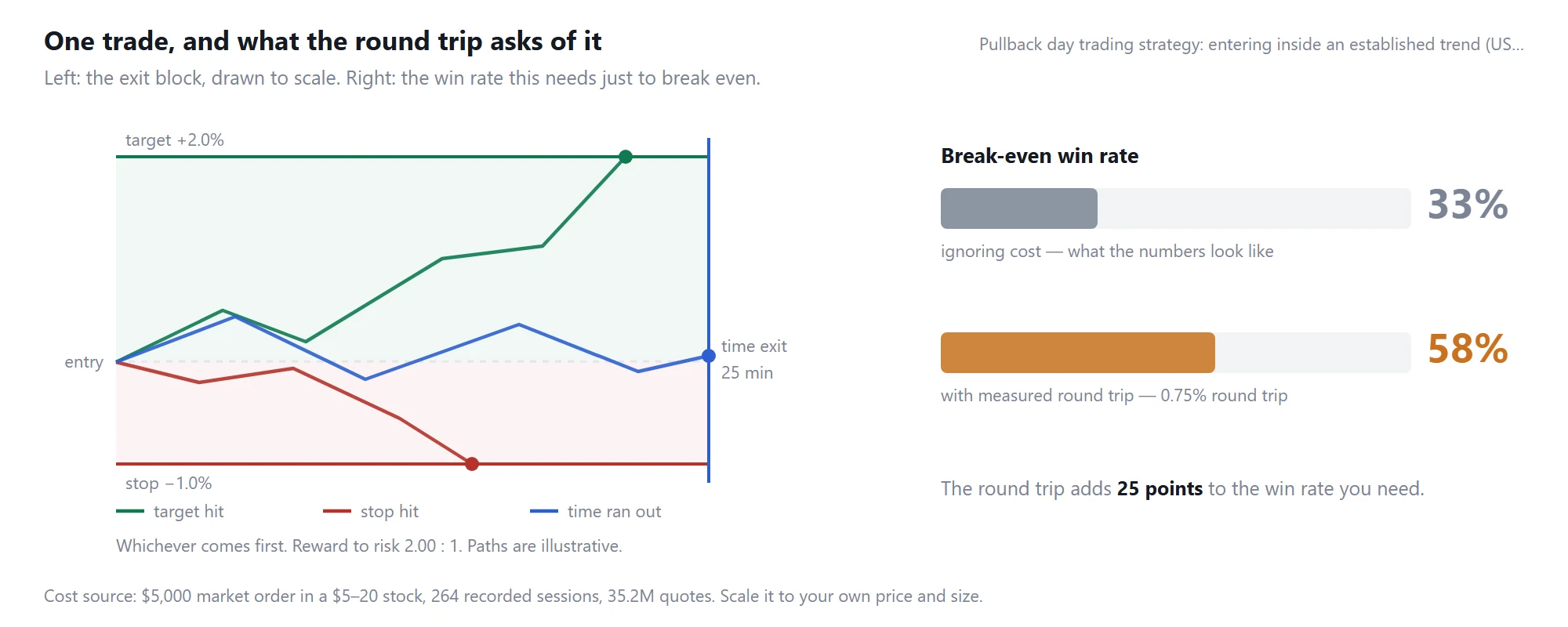
Pullback entry: the exit block drawn to scale, and the break-even win rate before and after measured trading costs
The 2.0% target against a 1.0% stop needs 33% on paper and 58% with the measured 0.75% round
trip (what day trading a US stock really costs).
Pullback entries earn their keep here in an indirect way. Because the entry is nearer the short
average, the stop can sit closer to a real reference rather than at an arbitrary distance — and a
tighter stop with the same target lowers the break-even. That, rather than a better hit rate, is
usually where the advantage comes from.
5. What to change first
Try the stop before the entry. If the pullback reference is genuinely useful, a 0.8% stop should
not cost you much in win rate, and it moves the break-even from 58% to around 55%.
Then check that you are not simply trading later versions of the same trend all day. Record the
time between consecutive entries on the same symbol; if it is under a few minutes, the pullback is
noise rather than structure. Backtest on your own data:
how to backtest a day trading strategy on US stocks.
Educational template for research and backtesting. Not investment advice and not a signal service.
Originally published by TraderWe on August 6, 2026. You may quote and link to this page. Republishing the full text without a link back to the original is not permitted.