Sooner or later everyone running an automated strategy asks the same question: should this live on my own machine, or in somebody's cloud?
We should declare our interest before answering it. TraderWe runs on your machine, so we are not a neutral party. What follows is the honest version anyway, including the parts where the cloud is genuinely better and the part where our approach costs you something real.
1. What the cloud genuinely does better
These are not small advantages and it would be dishonest to skip them.
Your computer can be off. Power cuts, Windows deciding to restart at 03:00, your internet dropping — none of it touches a strategy running in a data centre. This is the whole reason cloud bots exist.
Nothing to install, and you can manage it from a phone. Open a browser, change a parameter, done. No app, no updates, no machine that has to stay healthy.
The servers sit near the exchange. Physical distance is latency, and a data centre next to the matching engine will always beat a laptop in a living room. For strategies that live or die on milliseconds, this matters.
If those three things are what you need, a cloud bot is the right answer and you should stop reading here.
2. What you hand over to get it
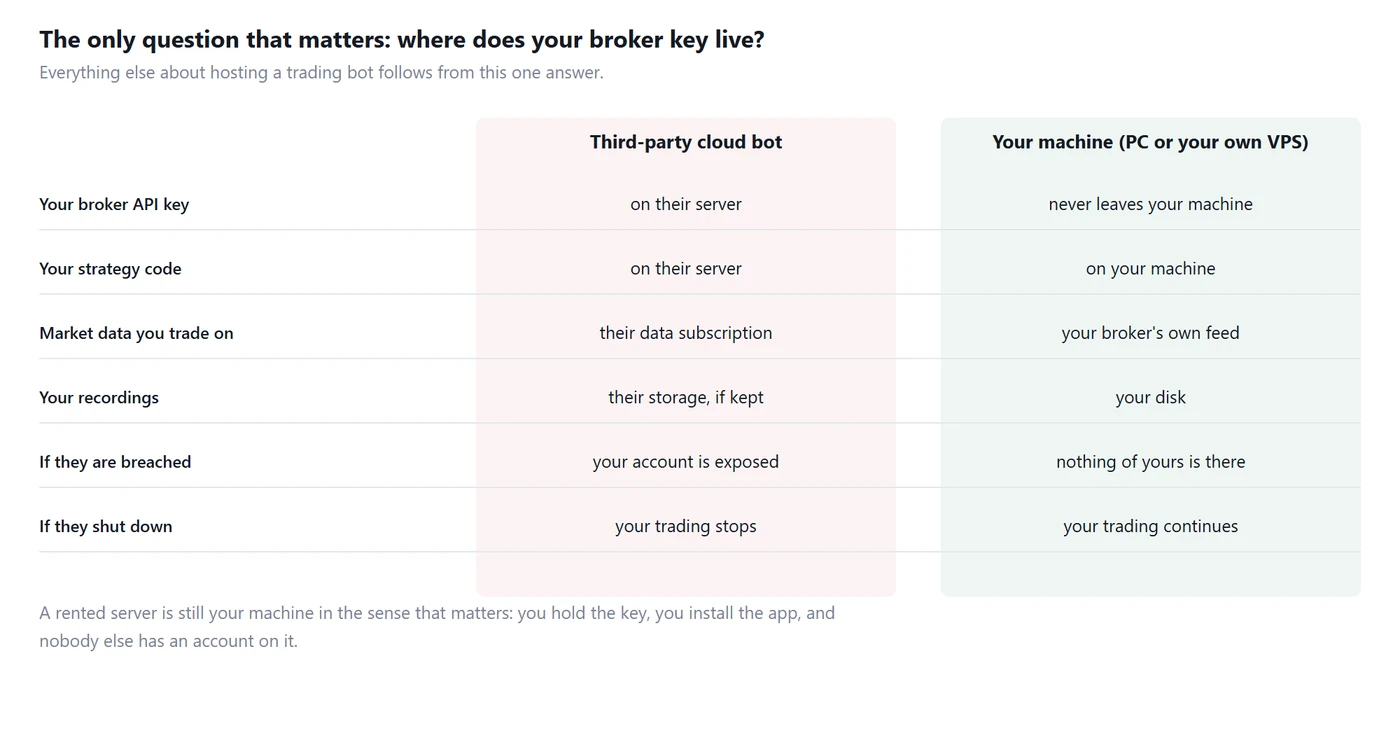
Where each part of a trading bot lives, third-party cloud versus your own machineYou give someone else the ability to trade your account. This is the big one. A cloud bot needs your broker API key, which means the key is stored on their server. If that company is breached, the attacker does not get your password — they get something better, which is trading permission on a funded brokerage account. Your security is now their security, and you have no way to inspect it.
If they go down, your trading goes down. And you will find out late. A service that quietly stops routing orders looks exactly like a market where your conditions did not trigger. There is no error on your screen because nothing errored on your screen.
Your strategy sits on their machine. Whatever the terms of service say, the rules you spent months developing are text on a server you do not control, readable by anyone with database access. If the edge is real, it is worth something to somebody.
The market data is theirs, not yours. This one is subtle and it is the reason we built things the way we did. A cloud service backtests you on the data feed it bought. You then trade through your own broker, on your broker's feed. Those are two different descriptions of the same market.
We have measured how different feeds can be. In our crypto cost study the quoted spread for the same instruments ranged from 3.0 to 8.1 basis points depending on venue, and the venue quoting tightest was not the venue filling largest. A strategy tuned on one feed and executed on another is being judged by one referee and paid by a different one.
You pay per bot and per node. The pricing follows the architecture: they are renting you compute, so more strategies cost more money. This tends to discourage exactly the thing you should be doing, which is running many variations to find out which ones survive.
3. Why we chose the other way
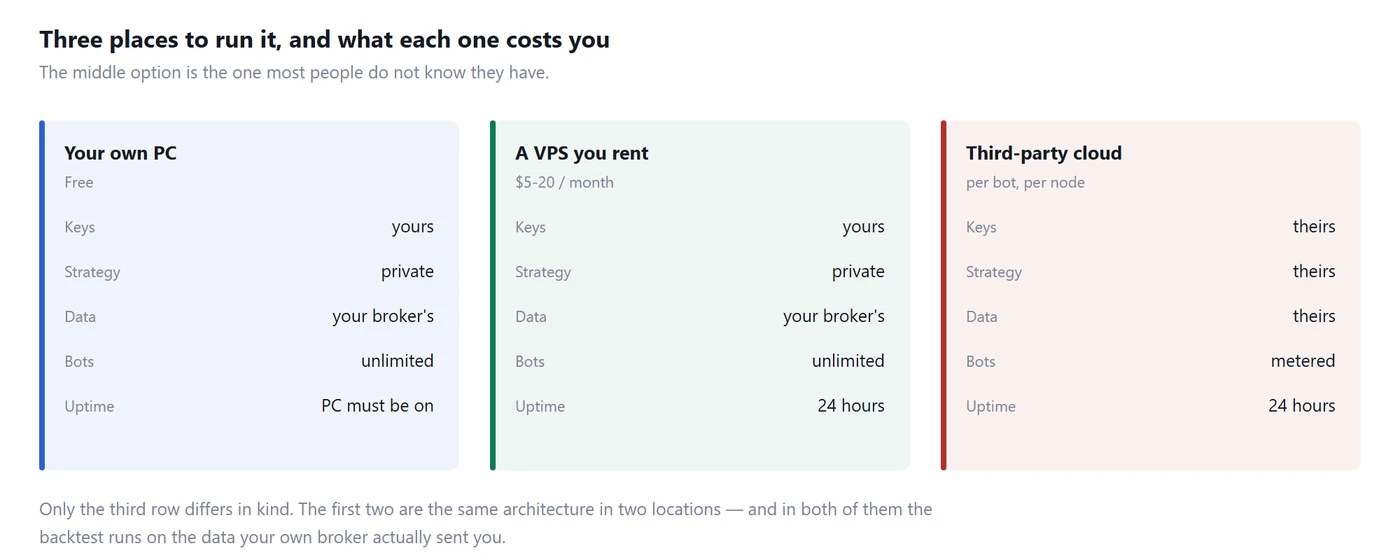
Three places to run a trading bot and what each one costs you
We decided that the safest thing we can do with your credentials is never receive them.
Your broker key never leaves your machine. It is not on our servers because there is nowhere on our servers for it to be. If TraderWe were breached tomorrow, there would be no brokerage keys in the breach.
Your recordings and your strategies are yours. They are files on your disk. We cannot read them, which also means we cannot lose them, hand them to anyone, or hold them hostage if you stop paying.
Run as many bots as you like. There is no per-bot charge because we are not renting you a machine. You already have one.
The backtest runs on the data your broker actually sent you. This is the part we think is genuinely hard to copy. When you record, you are recording your own feed — the same prices, the same ten levels of book, with the same gaps and quirks your live strategy will see. The backtest is a replay of your market, not a reconstruction of a market that resembles it.
A cloud service structurally cannot do this. It does not have your broker connection; it has its own. That is not a gap in anyone's engineering, it is what the architecture is.
4. What our way costs you
One thing, and it is real: your machine has to be running during the session.
That is the trade. We are not going to dress it up.
What we do about it is make the failure loud. The app keeps an outbound connection to our relay, and your phone gets a push notification when something goes wrong — the engine starting or stopping, a loss or profit limit being hit, a broker connection dropping, a position being liquidated.
The important one is handled differently. If your PC goes silent — power cut, internet down, app crashed. It cannot send you anything, because it is the thing that died. So the server watches for the silence instead: if the connection does not come back within 90 seconds, the server sends the alert itself. A dead machine cannot report its own death, so the absence of a heartbeat has to be the signal.
That does not keep your strategy running. It does mean you find out in a minute and a half rather than at dinner.
5. The option in the middle
Most people think this is a choice between two things. It is three.
Your own PC
A VPS you rent
Third-party cloud
Broker key
yours
yours
theirs
Strategy
private
private
on their server
Market data
your broker's
your broker's
their subscription
Number of bots
unlimited
unlimited
metered
Uptime
PC must be on
24 hours
24 hours
Cost
free
$5-20 a month
per bot, per node
Rent a small Windows server and install TraderWe on it. For five to twenty dollars a month you get a machine that never sleeps, never installs an update at 03:00, and sits on a data centre connection. The key is still yours. The strategy is still yours. The data is still your broker's, because it is still your broker connection. You simply moved the computer.
You manage it with Remote Desktop, and after setup you rarely touch it. If uptime is the only reason you were considering a cloud bot, this gets you the uptime without handing anyone your account.
The one thing it does not give you is co-location next to the exchange. A general-purpose VPS is closer than your house and further than a professional setup. If your edge needs single-digit milliseconds, none of the options in this article are really aimed at you.
6. How to decide
Choose a third-party cloud bot if you need managed uptime more than you need custody, your strategies are simple enough that you do not mind them living elsewhere, and you accept that the data you test on is not the data you trade on.
Choose your own PC if you are developing and testing, you trade during hours you are awake, and you want your keys and your research to stay where you can see them.
Choose your own VPS if you want continuous operation and still want to hold your own keys. This is what we recommend to most people who ask us about the cloud, and it is the option most of them did not know existed.
The question underneath all of this is simple enough to ask out loud: are you comfortable with somebody else holding permission to trade your account? There is a defensible yes and a defensible no. We built for the people who answer no.
Originally published by TraderWe on August 10, 2026. You may quote and link to this page. Republishing the full text without a link back to the original is not permitted.
Refreshing to see a vendor list the reasons you might not want their thing, though I notice the article stops right as it gets to the interesting part. My laptop has never restarted itself at 3am, but that's mostly because I stopped trusting it years ago and just don't hold anything overnight.
The latency argument only really binds for a narrow slice of strategies, and I suspect most people here are nowhere near that regime - my fills vary more from spread and order type than from where the machine sits. Has anyone actually measured the spread of their own round-trip times on home internet versus assumed it's fine?
The honest version of this is just expected cost on both sides. Ask yourself roughly how often you'd expect an outage on your own box, times what a missed or stuck position typically costs you, that's one number. Then the other side: probability someone else's server gets breached, times a much bigger fraction of the account. Neither number is knowable precisely, but writing both down usually tells you which risk you actually care about, and for most people the second one has a fatter tail even though it's rarer.
Honestly the 'your PC can be off' point is the one that stings for me, I've had Windows eat an update mid-session and it's not fun!! Curious what section 2 says because I want to know exactly what I'm giving up before I move anything.
Fair callouts from everyone - the piece is long and the extract here cuts off, the second half covers what you hand over when the strategy logic and keys live on someone else's box. Short version: local means the machine has to be awake and healthy, and that's a real cost we don't pretend away. On latency, we'd agree with QuietVol that most retail timeframes aren't where that decides anything, but if yours is, cloud is the honest answer.