A mean reversion day trading strategy for US stocks: fade a sharp drop, but only once the drop has
stopped. When price has stretched far below its own average with sell pressure still dominant, the
snap-back is the trade — and the hard part is not the entry, it is refusing to take it too early.
1. The rule
# BUY — the fall has to have stopped first
if ChangePct < -4 and Strength < 60 and Price > LowestPrice(120):
    Buy()
# SELL
if ProfitPct >= 1.0 or ProfitPct <= -0.8 or HoldTime >= 1200:
Sell()
2. Why these conditions
Line
What it asks
Why
ChangePct < -4
Down more than 4% today?
The move has to be big enough to be worth fading.
Strength < 60
Are sellers still dominant?
That imbalance is *why* the price is low.
Price > LowestPrice(120)
Is price off its two-minute low?
The part people leave out. Without it you are buying while it is still falling.
Strength is cumulative buy volume over cumulative sell volume times 100, capped at 500. Below
100 means sellers have been hitting the bid on balance.
Remove the third condition and this becomes a knife-catching strategy. That single line is the
difference between fading an exhausted move and standing in front of one.
3. When it fails
It fails when the drop is news-driven and the news is still developing. Price comes off the low,
triggers the entry, and makes a new low ten seconds later. Nothing in these conditions can tell
the difference between a technical flush and a company in trouble.
It also fails on very low-priced names, where a four percent move is one tick and the spread is
another. We measured that: a third of all quotes in this population are already one cent wide, and
on a $1.50 stock that single cent is a 0.67% round trip
(what day trading a US stock really costs).
4. What the round trip asks of it
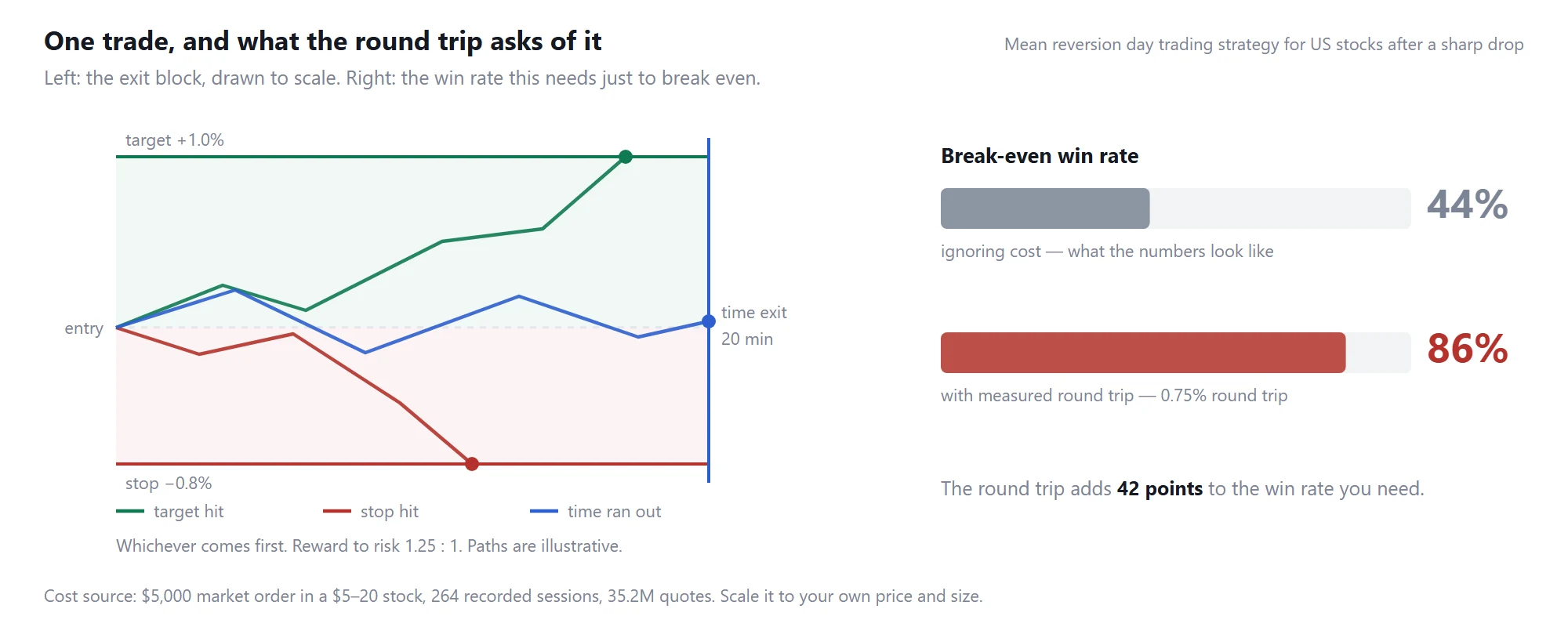
Mean reversion: the exit block drawn to scale, and the break-even win rate before and after measured trading costs
This is the uncomfortable one. A 1.0% target against a 0.8% stop needs to be right 44% of the time
before costs. With the measured 0.75% round trip it needs 86%. A counter-trend strategy with a
one percent target is, on this population, structurally very hard.
The fix is not a better entry. It is a bigger target or a cheaper population — which is exactly
what the first change below does.
5. What to change first
Add a liquidity floor before you tune anything. DayAmount > 5000000 on the entry line removes
the names where the fill costs more than the reversion is worth — see
liquidity filter you can put in front of any day trading entry.
Then widen the target. Going from 1.0% to 2.0% moves the break-even from 86% to 55% without
touching the entry at all. After that, try LowestPrice(300) instead of LowestPrice(120): a
longer confirmation window means fewer and later entries, which is usually the right trade for a
counter-trend idea. Test it on your own recordings —
how to backtest a day trading strategy on US stocks.
Educational template for research and backtesting. Not investment advice and not a signal service.
Originally published by TraderWe on August 5, 2026. You may quote and link to this page. Republishing the full text without a link back to the original is not permitted.
Stop at -0.8 and target at +1.0 means you need better than about a 45% hit rate just to tread water, and fading a -4% move is exactly where people talk themselves into 'just a little wider' on the stop. If you run this, size it so 3 losers back to back is boring, and write down the max attempts per day before you start.
1s charts, 20 minute holds, catching knives... you lot are doing more work before lunch than I do in a quarter. No shade, just enjoying my coffee while the reversion happens on my daily bars.
Where does VWAP actually enter the code? The entry only uses ChangePct, Strength and a 120-bar low. Are those standing in for distance from VWAP, or is the real rule supposed to be a VWAP gap threshold?