Not an entry on its own — an order flow filter to put in front of one. It asks whether the tape
agrees with the direction you want to take, using second-by-second flow rather than price.
1. The rule
# BUY — 09:30-16:00 ET, flow must agree
if HhmmSs >= 93000 and HhmmSs < 160000:
    if BuyVol > TotalAskSize * 0.6 and SellVol < TotalBidSize * 0.6:
        if TotalAskSize < TotalBidSize * 6 and TotalBidSize < TotalAskSize * 3:
            if Volatility(30) >= 0.2:
                Buy()
# SELL
if ProfitPct >= 1.2 or ProfitPct <= -0.6 or HoldTime >= 600:
Sell()
2. Why two book-ratio lines instead of one
They look redundant and are not.
Line
Rejects
TotalAskSize < TotalBidSize * 6
a book stacked against you
TotalBidSize < TotalAskSize * 3
a book stacked so far in your favour it is probably about to be pulled
The second one is the counter-intuitive half. Resting size that looks too good is frequently size
that will not be there when price arrives, and a filter that only screens one direction will walk
you straight into it.
Volatility(30) >= 0.2 is the coefficient of variation over the last thirty seconds. Without it
the gate passes on names that are not moving at all, where a fill costs you the spread and returns
nothing.
3. What the flow comparison assumes
BuyVol > TotalAskSize * 0.6 compares traded volume against resting size, which only means
something if your feed publishes real depth. Not all do, and quoted size is not the same as
available size — we measured that the quoted price is typically good for only about $1,200 to
$5,200 before you start walking the ladder
(order book depth measured).
If your broker gives you one level rather than ten, this gate is reading a much smaller number than
it thinks it is.
4. What the round trip asks of it
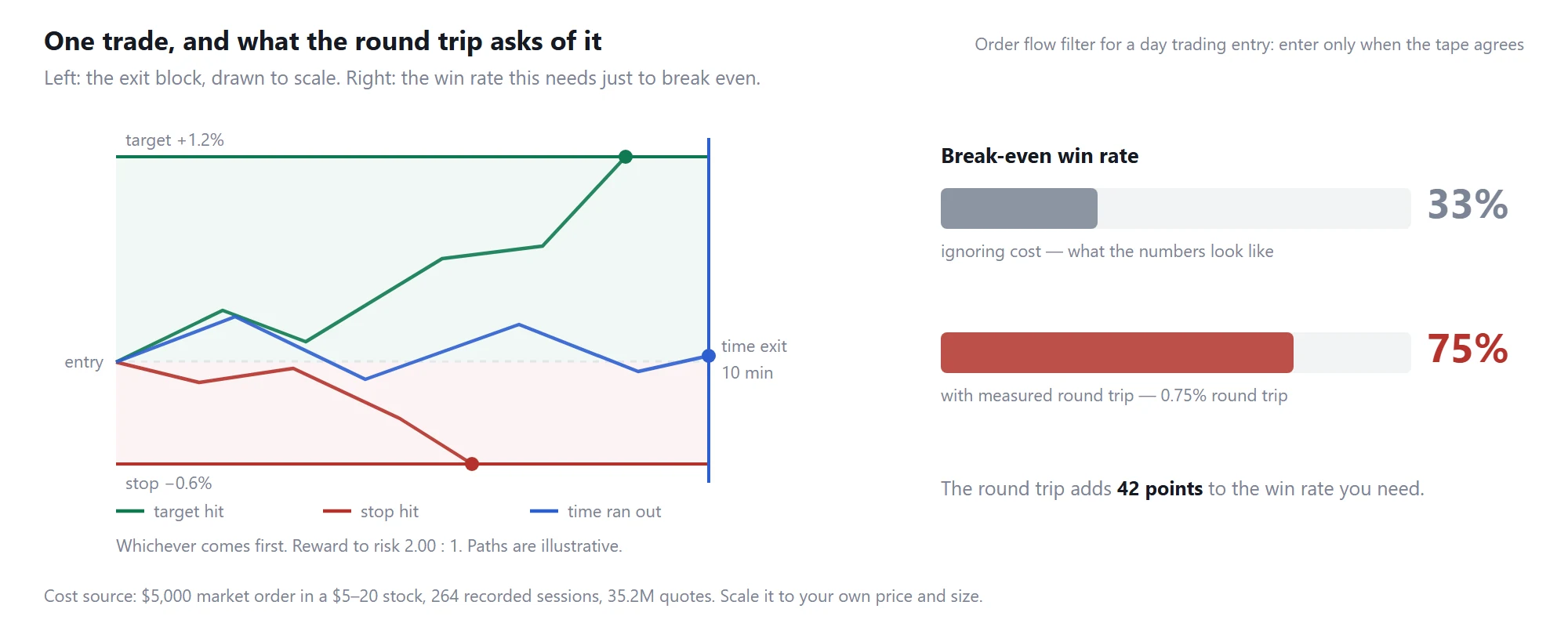
Order flow filter: the exit block drawn to scale, and the break-even win rate before and after measured trading costs
Here is the tension in this strategy. The 1.2% target against a 0.6% stop needs 33% on paper and
75% with the measured 0.75% round trip
(what day trading a US stock really costs).
A short-hold, tight-target gate is exactly the shape that costs hurt most. The gate itself is
sound, but paired with a 1.2% target on the median-cost population it has almost no room. Put it in
front of an entry with a wider target instead — which is what it was written for.
5. What to change first
Use it as a filter, not as a strategy. Take an entry you already have with a 2.5% or 3% target,
add these conditions in front of it, and compare trade count and win rate. That is the comparison
this block is designed to win.
If you do run it standalone, widen the target before touching anything else. Backtest on your own
recordings: how to backtest a day trading strategy on US stocks.
Educational template for research and backtesting. Not investment advice and not a signal service.
Originally published by TraderWe on August 13, 2026. You may quote and link to this page. Republishing the full text without a link back to the original is not permitted.
ok the part that stuck with me is the idea that a book stacked way too much in your favour is a warning sign, not a gift. i mostly trade coins overnight and depth there gets yanked constantly, so i might try the two-sided ratio thing instead of just checking one side like i've been doing 😅
Displayed size lies, son. I watched books stacked five deep vanish the instant anyone leaned on them, back when that still surprised people. Your second ratio is the right instinct but 3x is a guess dressed as a rule, I'd want to see how often it saved you versus how often it just kept you out of a good one. And 09:30 sharp is the one minute of the day where the tape agrees with everything and means none of it.
Two ratio bounds instead of one is a nice touch, but I'd want to see how often each line is the binding one before I trusted the asymmetry, if the "too good" side almost never triggers, it's cosmetic. Also, since the exit mixes a target, a stop and a time cap, the effective win rate and payoff shift with whichever one dominates, and that's the number that actually drives how much I'd size per attempt.