For twenty-five years the answer to this question was a number: $25,000. That was the
pattern day trader minimum, and it decided who could day trade US stocks and who could not.
It is gone. As of June 4, 2026 the $25,000 minimum and the "pattern day trader" designation itself
no longer exist.
That changes the regulatory answer. It does not change the market's answer, and the market's answer
is the one that decides whether a small account can actually work. We have 264 recorded sessions and
35,207,932 quotes of order book data to put against it, so this article covers both.
1. What actually changed on June 4, 2026
FINRA amended Rule 4210. The amendment removes, in their entirety, the old day trading margin
requirements — including the day-trade count used to designate someone a pattern day trader, and
the $25,000 minimum equity requirement that came with it.
Before
After June 4, 2026
Four day trades in five business days made you a "pattern day trader"
The designation no longer exists
That designation required $25,000 minimum equity
Requirement eliminated
Restriction was based on how often you traded
Requirement is based on the risk you actually carry intraday
What replaces it is a risk-based intraday margin standard. Brokers now monitor every margin
account for intraday deficits regardless of trading frequency, either by blocking trades in real
time or by calculating at the end of the day and issuing a margin call.
The rule was introduced in February 2001, after the dot-com bust, at a time of high commissions and
almost no real-time risk monitoring. Both of those conditions changed a long time ago.
Primary sources: FINRA Regulatory Notice 26-10 and the
interpretations of Rule 4210 valid from June 4, 2026.
2. The part most articles leave out
Firms have up to eighteen months — until October 20, 2027 — to implement the change.
That means the rule is gone but your broker may not have caught up. If your account still shows a
day-trade counter, or still blocks your fourth trade, that is not an error and complaining about the
SEC will not help. Check your own broker's current policy rather than assuming the headline applies
to you today.
Two other things did not change:
The $2,000 margin account minimum still applies. That is Rule 4210(b)(4), a general margin
account requirement that predates the PDT rule. It was never the PDT number and it is not a
replacement for it. It does not apply to cash accounts.
Cash accounts still settle. If you trade in a cash account you are still limited by settlement,
which is a different constraint that this amendment does not touch.
3. So what does the market actually require?
Here is where a measured answer beats a regulatory one. We walked recorded ten-level order books and
priced what a market order would really have paid, across 264 sessions.
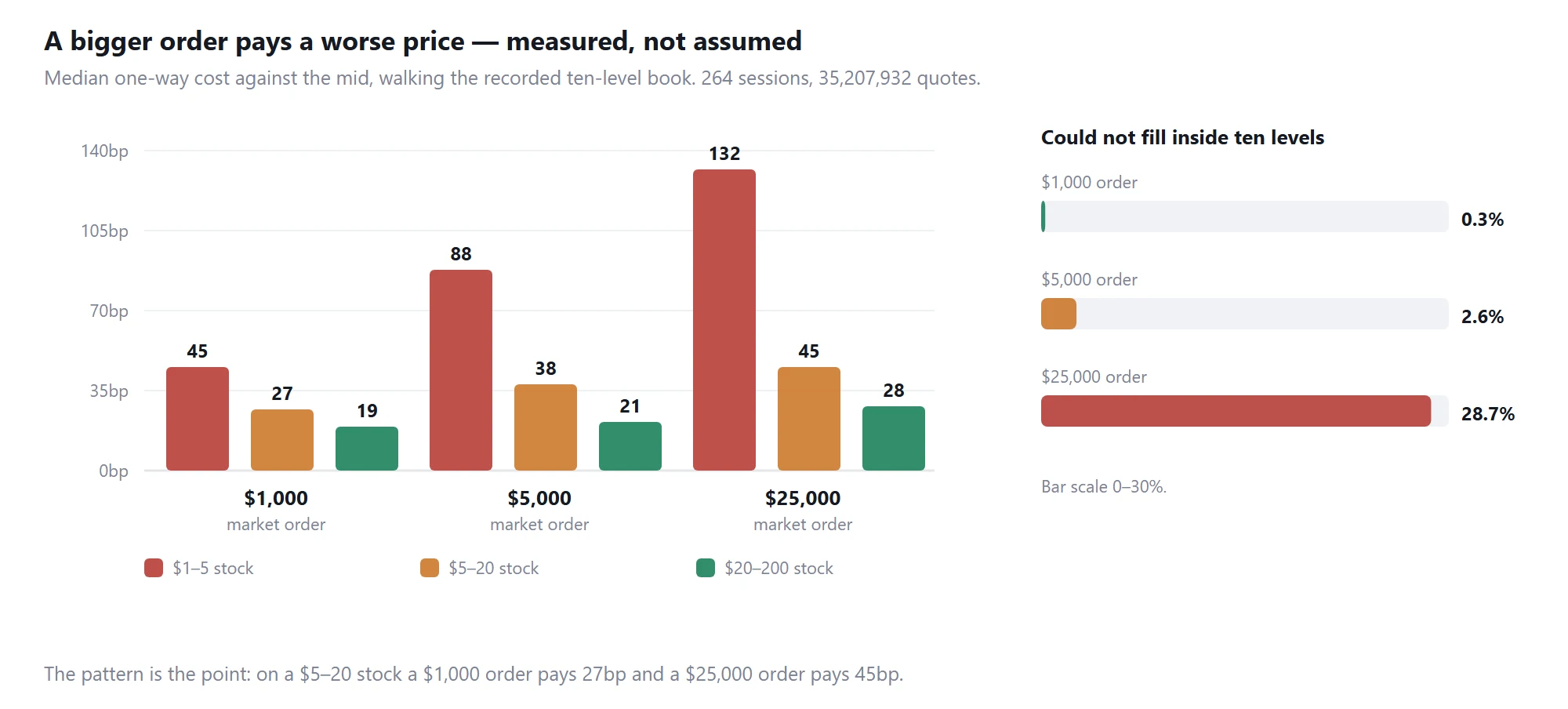
What a market order pays by order size: median one-way cost across 264 recorded sessions, and how often an order could not be filled inside ten levels
The left panel is the surprise. On a $5–20 stock:
Order size
Median one-way cost
$1,000
27bp
$5,000
38bp
$25,000
45bp
A $25,000 order pays roughly 1.7 times what a $1,000 order pays for exactly the same trade in
exactly the same stock. On a $1–5 stock the gap is wider still: 45bp versus 132bp.
The right panel is the harder constraint. A $1,000 order could not be filled inside ten levels only
0.3% of the time. A $25,000 order failed 28.7% of the time — more than one attempt in four.
4. Why a small account gets better fills
Because the quote is thinner than it looks. We measured how much size sits at the best offer before
you start walking up the ladder:
Stock price
Available at the best offer
Available within 25bp
$1–5
$1,155
$1,871
$5–20
$1,909
$8,696
$20–200
$5,150
$43,882
A $1,000 order on a $5–20 stock usually fits inside the top of the book and pays close to the quote.
A $25,000 order in the same name does not fit, so it walks — and every level it walks up is a worse
price than the one you saw.
This is a real, structural advantage for a small account, and it is the opposite of what most
articles about account size will tell you. Details in
the quoted price is only good for about $1,200 to $5,200.
5. What every trade costs, whatever your account size
The advantage above has a limit, because cost is charged as a percentage. Even at the favourable end,
a round trip on a $5–20 stock is roughly 0.75% before commission and before being right about
direction (what day trading a US stock really costs).
That number sets a floor on what a strategy has to earn:
Target / stop
Break-even win rate ignoring cost
With a 0.75% round trip
0.8% / 0.5%
38%
96%
1.5% / 0.8%
35%
67%
2.0% / 1.0%
33%
58%
3.0% / 1.5%
33%
50%
Two things follow, and they matter more than the account minimum.
Small targets do not work on this population. A 0.8% target needs a 96% win rate. That is not a
strategy, and no amount of starting capital fixes it.
Trade frequency is what actually drains a small account. The cost is per round trip, so twenty
trades a day charges you twenty times. On a $3,000 account, twenty round trips a day at 0.75% is
0.15% of the account per day in pure friction if you are trading $100 positions — and far more if
you are not.
6. A practical answer
There is no longer a regulatory number, so here is a framework instead.
Ask what one position will be. If you want to hold five positions at $1,000 each, you need
$5,000 plus room to be wrong. Position size, not account size, is what determines your fill quality.
Ask how often you will trade. Multiply your expected round trips per week by 0.75% of position
size. If that number is a meaningful fraction of what you expect to earn, trade less or target more.
Ask whether your strategy's target clears the toll. Use the table in section 5. This is a
five-second check and it eliminates most strategy ideas before you write any code.
Then check your own broker's current policy, because of the phase-in above.
7. Test it before you fund it
None of the above is a substitute for measuring your own fills. A backtest that assumes you transact
at the last trade price is not measuring any of this — the last trade price is frequently not a price
you could have traded at (here is how often).
Record your own market, backtest against the recording, and price the round trip honestly:
how to backtest a day trading strategy on US stocks. If you want a starting point that
already includes a liquidity check, this filter goes in front of any entry, and
the baseline your strategy has to beat is worth running before anything of your own.
Originally published by TraderWe on August 17, 2026. You may quote and link to this page. Republishing the full text without a link back to the original is not permitted.
So the gate goes away and now the broker just watches what you're actually risking intraday instead of counting how many times you clicked. Feels like they swapped a dumb rule for a smarter one, which historically means fewer people notice it until it bites them.
The distinction I'd underline for anyone reading: the old threshold was a permission question, and the piece is right that permission was never the binding constraint. Cost per round trip relative to account size is. If your fixed frictions are a meaningful slice of your average winner, the maths says you need either a bigger edge or fewer trades, and no regulator can amend that. I'd have liked the article to spell out how they measured the liquidity side, though, because "order book data" covers a lot of very different assumptions about where you actually get filled.
What struck me is that the barrier being lifted might be harder on people than the barrier existing. Nothing external stops you now, so the discipline has to come from inside, and that's the part most of us are least practised at.